








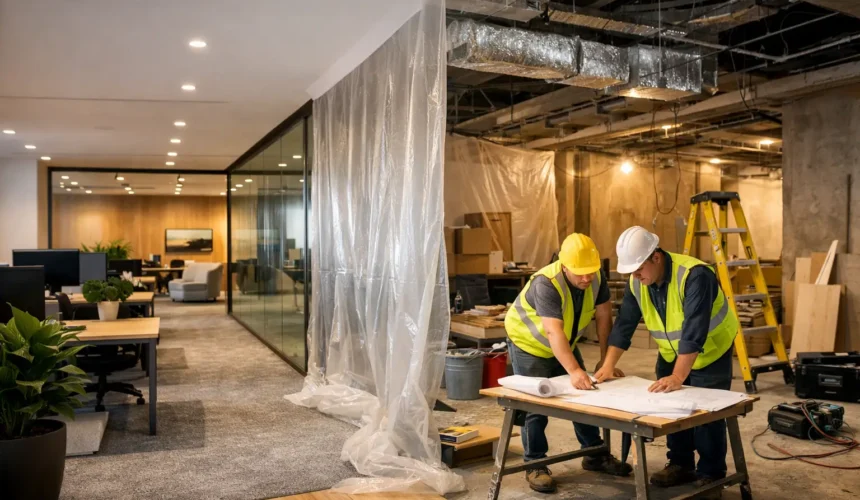
The best commercial spaces never feel phased. They feel intentional from day one, controlled during construction, and ready for business the moment each zone opens. That is the real question behind how to phase commercial fitout work. Not how to split a project into smaller pieces, but how to keep operations, schedule, design intent, and site safety aligned while the space changes around you.
For an office, that might mean teams stay productive while one wing is rebuilt. For retail, it means customers still recognize the brand while fixtures, lighting, and back-of-house functions shift behind the scenes. For restaurants, it often means protecting revenue by sequencing kitchen, dining, storage, and service areas with almost surgical precision. Phasing is not a workaround. Done properly, it is a delivery strategy.
What phasing really means in a commercial fitout
A phased fitout is not simply a project completed in stages. It is a fitout planned around continuity. One part of the space is under construction while another part remains active, protected, or scheduled for a later turnover. That sounds simple until real conditions enter the room – shared entrances, staff movement, inspections, lead times, noise restrictions, existing systems, and the simple fact that businesses still need to function.
This is why phasing is usually less about construction speed and more about construction control. If the sequence is wrong, trades stack on top of each other, temporary protections fail, operations get interrupted, and the client ends up managing confusion instead of moving toward an opening plan. The phase plan has to serve the business, not just the builder.
How to phase commercial fitout projects the right way
The first move is to define what cannot stop.
That may be customer access, staff circulation, emergency egress, washroom availability, inventory handling, or a partial operating schedule. Every successful phasing plan starts by identifying the functions the business must preserve at all times. If that is not documented upfront, the build team will make assumptions on site, and assumptions are where delays begin.
After that, the project needs a true scope lock. This is where many commercial interiors lose control. Teams start discussing phases before the drawings, finishes, millwork details, and field conditions are fully coordinated. The result is predictable – phase one opens walls and exposes missing decisions that affect phase two and three. A phased project cannot be built on a vague scope. It needs complete documentation before sequencing begins.
That is also why serious fitout planning includes more than a simple floor plan with colored zones. You need to understand dependencies. Can the new reception area go first if electrical infrastructure serving the existing front desk is being rerouted? Can a retail sales floor remain open if the stockroom upgrade removes product flow? Can staff relocate to a temporary workspace if data, access control, and acoustics have not been addressed? Every phase should stand on real operational logic.
Start with business continuity, not demolition
Owners often think in terms of areas. Builders need to think in terms of systems.
A zone on a plan may look independent, but once you trace lighting controls, life safety pathways, shared walls, ceiling grids, mechanical coordination, delivery access, and finish transitions, the picture changes. A smart phasing strategy begins by mapping what each area depends on and what it affects around it.
In practice, that usually leads to one of three structures. Some projects move front to back so customer-facing areas stay polished longer. Others move core to perimeter so infrastructure upgrades happen early and finish work follows cleanly. Occupied offices often require swing-space phasing, where one completed zone temporarily houses staff while the next zone is rebuilt.
There is no universal right answer. The right answer is the one that protects revenue, keeps occupants safe, and reduces rework.
The preconstruction work decides the outcome
If you want to know how to phase commercial fitout work successfully, look at preconstruction. The site rarely causes the biggest failures. Incomplete planning does.
Before any trade mobilizes, the team should have a documented scope, a phase-by-phase construction sequence, material selections, long-lead procurement timing, permit requirements, inspection pathways, and temporary protection measures. This is where a system matters. At Spartan Builders, that control starts before the first wall is touched. Scope definition, trade coordination, and milestone sequencing are not add-ons. They are the job.
Preconstruction should also identify what must be built twice and what should not. Temporary barriers, signage, rerouted access paths, short-term service counters, and temporary partitions may be necessary. But if you are rebuilding the same condition repeatedly because phases were not coordinated, that is not flexibility. That is waste disguised as adaptation.
Each phase needs its own turnover standard
A common mistake is treating phase completion like partial progress instead of operational handover. Every phase should end with a clear turnover condition.
That means the area is not just substantially built. It is clean, safe, functional, inspected where required, and ready for the people who need to use it next. In an office, that may include furniture placement, access control, data readiness, and acoustical completion. In retail, it may include merchandising readiness, lighting scenes, millwork protection removal, and customer path clarity. In hospitality, it may mean service flow actually works under live conditions.
This matters because the next phase often depends on the previous one being truly usable. If staff are meant to relocate into a newly completed zone but punch list items, missing hardware, or unresolved systems still remain, the entire sequence slips.
Communication has to match the complexity of the phasing plan
Phased fitouts create more moving parts than single-shutdown renovations. More transitions. More approvals. More chances for one change to affect three future steps.
That means communication cannot stay casual. Weekly updates are not enough if the team is making daily transitions between occupied and active construction areas. Decision logs matter. Milestone tracking matters. Site instructions matter. So does a single source of truth for what is approved, what is delayed, and what changes the sequence.
Clients do not need more noise. They need visibility. They need to know what is happening now, what opens next, and what decisions could affect occupancy dates. The builder’s job is to turn complexity into clarity.
How to handle trade-offs during phased delivery
Phasing always involves trade-offs. Pretending otherwise is how projects drift.
A faster sequence may create more after-hours work. Preserving operations may lengthen total duration. Protecting a premium customer experience may require temporary partitions, off-hour deliveries, or earlier procurement. Some clients prefer a longer project if it means continuity. Others choose a shorter, more intensive schedule with limited shutdown windows.
Neither approach is automatically better. The right call depends on business model, occupancy type, building rules, and operational tolerance. What matters is that those trade-offs are made deliberately, not discovered halfway through demolition.
This is also where design ambition and site reality need to stay connected. A beautiful commercial interior still has to be buildable in sequence. Specialty finishes, custom millwork, lighting packages, and inspection timing must fit the phase plan. If they do not, the project will either compromise the design or miss the schedule. Strong builders protect both by coordinating them early.
Risk points that deserve extra attention
Most phased fitout failures cluster around the same pressure points.
The first is hidden dependency. A ceiling replacement triggers sprinkler coordination, which affects inspections, which delays occupancy of the next zone. The second is material timing. One late millwork package can stall an entire handover. The third is poor transition planning between old and new conditions – uneven finishes, temporary patches, exposed services, and awkward customer routes that make the space feel unfinished for too long.
Then there is human behavior. Staff will use the shortest path, customers will ignore unclear barriers, and neighboring tenants will notice noise long before anyone files a formal complaint. A phase plan has to account for how people actually move through a space, not just how the drawings suggest they should.
Phasing works when the system is stronger than the pressure
Commercial fitout projects rarely fall apart because one wall was framed poorly. They fall apart because scope, sequencing, procurement, and communication were never disciplined enough to carry the pressure of a live environment.
That is why the strongest phased projects feel calm even when they are complex. The client knows what is happening. Trades know where they are going. Occupants know what changes next. The design still reads clearly at every stage. And each handover builds confidence instead of creating another list of unresolved issues.
If you are planning an occupied renovation, the goal is not to simply survive construction in pieces. The goal is to shape each phase so the business keeps moving, the space keeps improving, and the final result feels like it was always headed exactly where it arrived.