








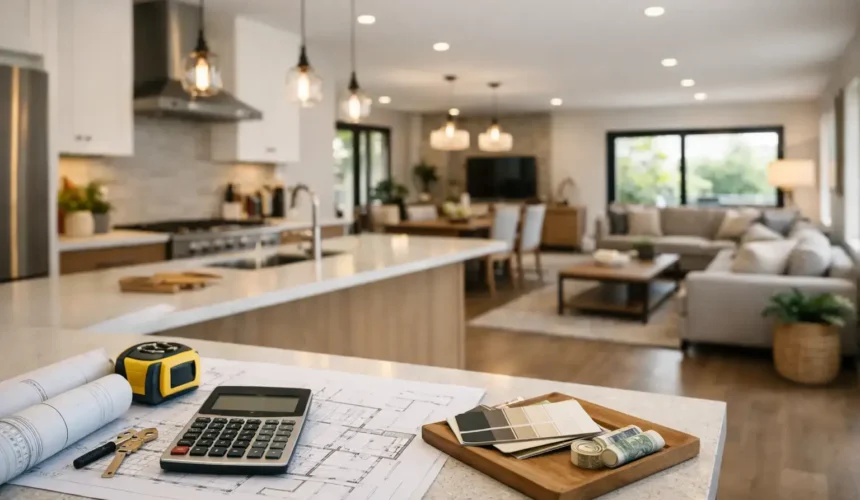
Picture the finished space first. The kitchen holds the room instead of hiding behind a wall. Light travels farther. Sightlines open up. The home feels calmer, larger, and more connected. That outcome is why open concept remodel costs are rarely just about demolition. You are not paying to remove a wall. You are paying to redesign how the home stands, flows, and performs.
That distinction matters because open layouts can be deceptively simple from the outside. A client sees one barrier between the kitchen and living area and assumes the budget lives in that single line. In reality, the wall is often the least important part of the scope. Structure, rerouting, permits, finishes, and sequencing are what shape the number.
What actually drives open concept remodel costs
The biggest cost variable is structural responsibility. If the wall is non-load-bearing, the work is more straightforward. If it carries floor or roof loads, the scope changes immediately. Now the project may require engineering, temporary support, beam design, posts, new footings in some cases, inspections, and a much tighter construction sequence.
That is why two homes with nearly identical layouts can produce very different pricing. One opens easily. The other needs real intervention to preserve structural integrity while creating a clean span. Homeowners often focus on the beam itself, but the beam is only one piece. The access required to install it, the repairs around it, and the finish work after it is in place usually add just as much weight to the budget.
Mechanical systems are the second major cost driver. Walls often carry more than drywall. They may hide supply lines, drains, electrical runs, vents, returns, or control wiring. Once the wall goes away, those systems need a new path. That rerouting can be minor, or it can trigger broader changes across ceilings, floors, and adjacent walls.
The third driver is finish integration. A true open concept should feel intentional, not patched together. That means flooring transitions disappear, ceiling planes make sense, lighting is rethought for the new room geometry, and cabinetry or millwork aligns with the updated sightlines. The more refined the final look, the more disciplined the scope has to be.
Typical open concept remodel costs by project type
For a simple non-structural wall removal with modest patching and repainting, pricing may start in the lower thousands. But that range can climb quickly once you move beyond basic removal into a complete room reconfiguration. In most primary living areas, homeowners should expect open concept remodel costs to land far above the price of demolition alone.
If the wall is load-bearing, the project often moves into a more serious budget category. Engineering, beam installation, inspections, temporary support, and finish restoration can push the investment well into the tens of thousands. If the remodel also includes a kitchen renovation, new flooring, lighting, cabinetry adjustments, or ceiling work, the number rises again because the project is no longer just structural. It becomes a full spatial redesign.
In higher-end homes, the spread is wider. That is not because the structural work is dramatically different. It is because the tolerance for compromise is lower. Flush beams, custom millwork adjustments, integrated lighting plans, wider-format flooring replacement, and higher-spec finishes all increase cost. The hidden truth in premium remodels is that making a major change look effortless is expensive.
Why structural walls change the conversation
A load-bearing wall removal is not a guess-and-go decision. It starts with assessment. The builder needs to understand what the wall is supporting, how the loads transfer, what spans are involved, and what the finished ceiling condition should look like.
This is where many budgets fail before construction even begins. Clients receive an early number based on wall removal, then discover later that a beam is required, the ceiling must be opened farther than expected, and the floor below needs investigation. The original price was never wrong so much as incomplete.
A controlled project starts with documentation. Scope first. Structural review first. Finish implications first. Without that, open concept remodel costs remain unstable because the real work has not yet been fully defined.
The hidden costs homeowners miss
Most homeowners understand permits and labor. Fewer account for the chain reaction. Once one wall comes out, adjacent surfaces become part of the project whether you planned for them or not.
The ceiling may need full refinishing to avoid an obvious patch line. Flooring may need to be replaced across a larger area if the existing material cannot be matched. HVAC registers may need relocation for balanced air movement in the new layout. Lighting may need to be redesigned because the room no longer has the same divisions. Trim profiles, paint sheen, and cabinet side panels can all become visible issues once the room opens up.
Then there is the question of levelness. Older homes are rarely perfectly true. Open layouts expose that reality. When walls disappear, subtle dips, transitions, and alignment issues become more visible. Correcting them is not always mandatory, but in a design-led remodel, leaving them unaddressed can undermine the result.
Open concept remodel costs in older GTA homes
In many older homes across the Greater Toronto Area, open concept remodel costs tend to rise because the houses were not built for modern open-plan expectations. Framing methods differ. Existing conditions are less predictable. Previous renovations may have introduced unpermitted or poorly documented work. And once the walls open, surprises are more common.
That does not mean older homes are poor candidates. Often they benefit the most from opening key spaces. It simply means the budget should reflect investigation, not assumption. In this context, pre-construction clarity is where the money is protected.
Why scope control matters more than the lowest number
The wrong way to price this type of project is to ask, “What does it cost to remove a wall?” The right question is, “What will it take to create an open space that is structurally sound, code-compliant, visually resolved, and fully finished?” Those are different conversations.
A low initial quote often excludes the work that makes the result feel complete. Engineering may be treated as extra. Ceiling refinishing may be minimized. Flooring integration may be left vague. Permit responsibility may not be clearly assigned. Change orders then fill the gaps.
This is exactly why process-led builders outperform traditional contractor models on remodels like this. Clear documentation before construction protects the budget because everyone is pricing the same scope. At Spartan Builders, that discipline is built into ClearScope, where material specifications, structural considerations, and finish requirements are documented before trades begin. That is how costs become predictable instead of reactive.
When an open concept is worth the investment
Not every home needs a fully open plan. Sometimes a partial opening delivers the better result. A wide structural opening between spaces can preserve some zoning while still improving light and circulation. In other homes, a complete opening is the right move because the kitchen, dining, and living spaces are competing against each other instead of working together.
The value comes from how the home lives afterward. Better visibility. Better flow. More natural gathering space. A layout that supports daily life instead of segmenting it. But the investment only makes sense when the redesign is intentional. Opening a floor plan without solving storage, lighting, furniture placement, and visual balance can leave the home feeling bigger yet less organized.
That is why open concept remodel costs should always be evaluated against the finished experience, not just the construction event. A wall coming down is a moment. A well-planned space changes the way the home works every day.
How to budget intelligently for an open concept remodel
Start with the assumption that structure, systems, and finishes are connected. If one changes, the others may need to move with it. Build your budget around complete scope, not isolated tasks.
You should also allow room for existing-condition discovery, especially in older homes or homes with prior renovations. That is not pessimism. It is disciplined planning. The cleaner the pre-construction investigation, the fewer surprises during execution.
Most of all, choose a team that can think beyond demolition. Open concept work sits at the intersection of design, engineering, architecture, and craftsmanship. When those disciplines are disconnected, costs drift and outcomes soften. When they are aligned, the project feels controlled from first drawing to final finish.
The best remodels do not simply remove boundaries. They replace them with clarity, proportion, and a better way to live in the home.