








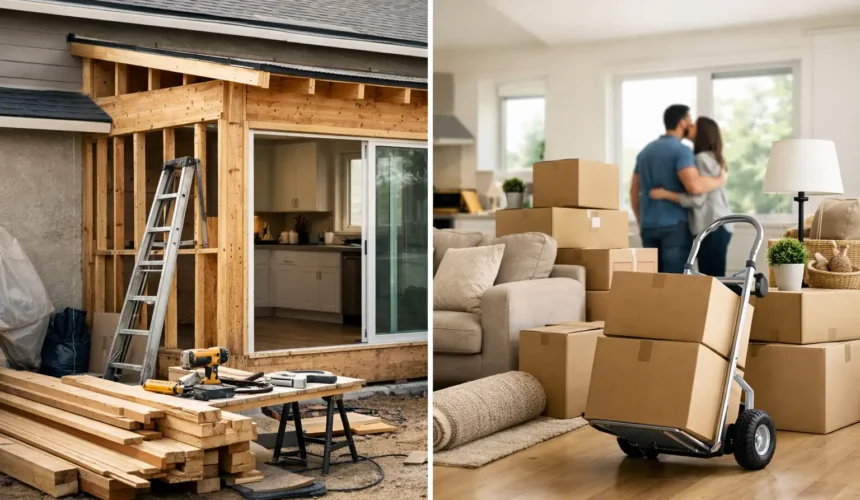
Picture the version of home that actually works. The kitchen opens the way it should. The primary suite feels separate from the noise. The family room finally has room for family. That is the real question behind home addition vs moving costs. You are not only comparing dollars. You are deciding whether to rebuild your daily life where you are, or start over somewhere else.
For most homeowners, the wrong decision is not the more expensive one on paper. It is the one made with incomplete numbers, vague assumptions, and no clear plan for what life looks like after the dust settles. A move can appear cleaner until closing costs, land transfer tax, higher mortgage payments, and immediate updates on the new property enter the picture. An addition can appear straightforward until structural complexity, zoning limits, and poor project coordination start pushing the budget off course. The better choice comes from control, not guesswork.
How to think about home addition vs moving costs
The cleanest way to compare these two paths is to separate financial cost from life disruption. Both matter. Both carry risk. And both can be managed when the scope is defined properly at the start.
A move usually begins with a purchase price difference. Then the secondary costs arrive fast. Selling fees, legal fees, moving services, utility setup, storage, minor repairs to prepare your current home for sale, and the upgrades your next home needs before it feels like yours. In a market like the Greater Toronto Area, that list gets heavier. Even when you buy a larger home, you may still inherit an outdated kitchen, undersized bathrooms, or a layout that solves one problem and creates three more.
A home addition works differently. Instead of paying to acquire a new property, you invest directly into the one you already own. The cost is concentrated in design, approvals, structure, building envelope, interior finishes, and site execution. If the plan is strong, the money goes where you feel it every day. More light. Better flow. Real function. The issue is not whether additions cost money. They do. The issue is whether that money creates tailored value or disappears into transaction costs and compromise.
The real cost of moving is rarely just the move
People often underestimate how expensive a move becomes once the first box is unpacked. The new house may be larger, but that does not mean it fits your life.
You might gain a bedroom and lose a workable kitchen. You might get a finished basement but inherit low ceilings, awkward circulation, or a main floor that still feels cramped. Many buyers end up renovating soon after buying because the new home only partly solves the original problem.
There is also the cost of resetting your routines. A longer commute. A different school route. New traffic patterns. Distance from family. Distance from the neighborhood businesses and services that make your week run smoothly. These costs are not line items on a closing statement, but they shape whether the decision feels smart six months later.
That is why home addition vs moving costs should never be reduced to a simple construction estimate versus a down payment calculation. One option changes your house. The other changes your entire operating system.
When a home addition makes more sense
An addition tends to be the stronger decision when the location already works and the house is the problem. If you like your lot, your street, your school zone, and your proximity to work or family, moving can be an expensive way to avoid redesigning the one thing that actually needs to change.
This is especially true when your current home has clear potential. A second-story addition can transform a crowded main floor house into a long-term family home. A rear extension can turn a broken kitchen and dining layout into the center of the home. A well-planned side or back addition can create a proper mudroom, office, bedroom suite, or larger living space without sacrificing the character that made you buy the house in the first place.
The key is disciplined planning. Additions fail when they start with a rough idea and no complete scope. They succeed when every major decision is documented before construction begins – structure, materials, sequencing, site conditions, and how the new space ties into the old one. That level of control is what protects both budget and schedule.
When moving may be the better financial decision
There are cases where moving is the more rational call. If your home has severe physical limits, the addition you want may not be viable. Zoning restrictions, lot setbacks, structural constraints, or the cost of reworking too much of the existing house can shift the math.
Moving can also make sense if your needs are broader than space alone. If you need a different neighborhood, a shorter commute, or a completely different property type, an addition will not solve the core issue. For some families, the house is not just too small. It is in the wrong place for the next chapter of life.
The mistake is assuming a move is automatically simpler. It may be faster in some cases, but not necessarily easier. You still need clear numbers. You still need to account for renovation needs in the new house. And you still need to evaluate whether you are paying a premium for square footage that is not designed around how you live.
Hidden costs that change the answer
This is where the decision gets real. On paper, one option often looks cheaper until the hidden costs are exposed.
With moving, hidden costs often include carrying two properties during the transition, temporary storage, rushed cosmetic updates to list your current home, furniture that no longer fits, and post-purchase renovations. Buyers rarely walk into a larger house and change nothing.
With an addition, hidden costs usually come from incomplete pre-construction planning. Existing structural surprises, poor site investigation, vague allowances, and disconnected trades can create overruns that were avoidable from the start. The problem is not the addition itself. The problem is treating a major structural project like a loose collection of trade tasks instead of a controlled build.
This is where systems matter. Clear scope documentation. Material selections made before mobilization. Sequenced scheduling. Milestone tracking. A vetted trade network. Without that framework, homeowners are not comparing home addition vs moving costs. They are comparing one defined path against another undefined one.
Resale value matters, but livability matters more
Homeowners often ask which option protects resale better. That is a fair question, but resale should not dominate the decision if you plan to stay.
A well-designed addition can strengthen property value, especially when it adds meaningful square footage and improves layout quality, not just size. But value is not created by square footage alone. It is created by proportion, function, design continuity, and execution. A poorly integrated addition can feel obvious in the worst way. A well-resolved one feels like the house was always meant to be that way.
Moving may place you in a home with stronger resale upside, but you are also buying at current market pricing and absorbing transaction costs immediately. The better financial story depends on timing, neighborhood, and how much work each house requires. There is no universal winner.
What is universal is this: if you stay, make the home work fully. Half-solutions are expensive.
The better question to ask before you decide
Instead of asking which option is cheaper, ask which one gives you the right result with the least waste.
If your current home can be transformed into a better version of itself, an addition often creates more direct value. You keep the location you chose, avoid many transactional losses, and invest in spaces designed around your life rather than someone else’s floor plan.
If the property cannot support your future, moving may be the cleaner choice. But make that decision with complete numbers, not instinct. Compare transaction costs, renovation needs in the new house, financing changes, timeline impact, and daily-life disruption. Then compare that with a documented addition scope, not a loose square-foot estimate.
That difference matters. A rough number creates false confidence. A defined plan creates decisions you can trust.
For homeowners who want more space without giving up everything that already works, the answer is often not to leave. It is to build with clarity, control, and a design that earns its footprint. The best decision is the one that gives your next chapter room to happen – without introducing a new set of problems you did not plan for.