








A fire does not just damage a building. It breaks continuity. One day you have a home, office, retail space, or multi-unit property that works. The next day, every decision carries weight – safety, code, insurance, schedule, design, and the final standard of the rebuild. That is why large loss fire restoration Toronto projects cannot be treated like basic repairs. They require command.
When the loss is significant, the real challenge is not only what burned. It is what became uncertain. Structural stability. Hidden smoke migration. Water introduced during suppression. Damaged assemblies behind finished surfaces. Delayed approvals. Incomplete scopes. Trades arriving out of sequence. This is where many projects drift. Not because the damage was impossible, but because the rebuild was never truly organized.
What large loss fire restoration in Toronto actually involves
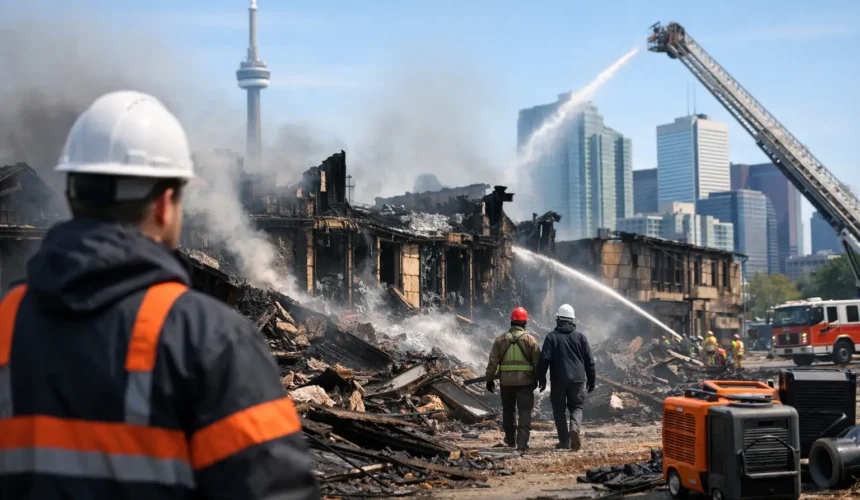
A large loss fire claim usually reaches far beyond visible damage. The obvious areas get attention first – charred framing, destroyed finishes, compromised ceilings, broken glazing, ruined millwork. But major losses often spread through multiple systems at once. Heat can weaken structural elements. Smoke and soot can travel into cavities, corridors, adjacent units, and mechanical chases. Water can affect flooring, insulation, drywall, and concealed assemblies that looked intact on day one.
In residential projects, that may mean a full interior rebuild after partial structural loss. In commercial spaces, it can mean restoring both the shell and the operational logic of the business – layout, accessibility, life safety, finishes, equipment coordination, and occupancy requirements. In either case, the work is not one trade solving one problem. It is a coordinated reconstruction effort.
That distinction matters. A large loss project is not cleanup plus construction. It is documentation, investigation, code review, engineering input, scope alignment, material planning, sequencing, and disciplined execution under pressure.
Why large loss fire restoration Toronto projects go off track
The industry has a familiar failure pattern. The initial response is fast, but the rebuild scope stays vague. Demolition starts before documentation is complete. Assumptions replace verified conditions. Insurance, consultants, and contractors work from slightly different versions of the job. Weeks pass. Change orders multiply. Deadlines move. Confidence drops.
On a small project, that kind of looseness is expensive. On a large loss project, it becomes destructive.
The bigger the claim, the more dangerous incomplete scoping becomes. Fire-damaged properties often need structural review, code-triggered upgrades, permit coordination, material lead-time planning, and careful sequencing across demolition, remediation, framing, insulation, drywall, finishes, millwork, and final closeout. If those pieces are not aligned early, the site may stay active while the project itself stops moving.
That is why sophisticated clients, adjusters, and design professionals look past promises and look for systems. They want to know how the scope will be defined, how trades will be controlled, how milestones will be tracked, and how communication will happen when conditions change.
The rebuild matters as much as the recovery
After a major fire, people often focus on urgency first. That makes sense. You want stabilization, safety, and a path forward. But speed without structure creates a second problem after the first one.
The right restoration approach protects two outcomes at once. It restores what was lost, and it rebuilds the property to a standard that feels resolved rather than patched together. That can mean matching architectural intent in a custom home. It can mean restoring a commercial interior so the business returns with credibility intact. It can mean correcting weaknesses exposed by the loss while staying aligned with code, approvals, and the claim.
This is where process-led builders separate themselves from generic restoration workflows. A serious rebuild is not driven by guesswork in the field. It is driven by documentation before execution.
At Spartan Builders, that starts with ClearScope™ – a complete scope and material definition system built to reduce ambiguity before trades begin. On a large loss fire restoration Toronto project, that level of scope control is not a branding exercise. It is protection. It reduces missed items, keeps expectations aligned, and gives every stakeholder a documented reference point when the site conditions become more complex.
Fire damage is rarely one problem
Large fire losses create layers. Structural damage may be the headline issue, but secondary and tertiary impacts often shape the rebuild.
Smoke residue can affect surfaces far from the source area. Water from fire suppression can create its own demolition and replacement path. Code review may trigger additional work when walls, exits, assemblies, or accessibility elements are reopened. Existing deficiencies that were hidden before the loss may now need to be addressed as part of the reconstruction.
There is no universal formula here. Some projects are primarily structural. Others are finish-heavy but broad in scope. Some require selective rebuilds around occupied sections. Others need complete interior reconstruction. It depends on the building type, the fire path, the suppression response, and how the existing property was built in the first place.
That is why broad promises are not enough. Serious fire restoration requires enough technical discipline to distinguish between what must be replaced, what can be preserved, and what has to be redesigned to move the project forward cleanly.
Coordination is the real work
The visible construction is only part of the job. Large loss restoration lives or dies on coordination.
That means coordinating with consultants, engineers, designers, adjusters, and inspectors. It means aligning demolition findings with updated scope. It means knowing when a material substitution will affect schedule, compliance, or finish continuity. It means managing trades in the right sequence so one phase does not compromise the next.
This is especially important in the Greater Toronto Area, where permit pathways, building conditions, and occupancy expectations vary widely from one project to another. A downtown mixed-use property does not rebuild like a detached home in North York. A restaurant rebuild has different constraints than a private residence in Vaughan or a commercial unit in Mississauga. The core principle stays the same, but the execution strategy changes.
That is why trade quality alone is not enough. Even excellent trades underperform inside a poorly run project. The builder has to control the sequence, the handoffs, the documentation, and the standards.
The Builders Plug™ was created for exactly that reason – a vetted network of licensed and insured trade partners working inside a controlled delivery structure. In large loss work, this matters because rebuild quality is inseparable from rebuild coordination. You do not need isolated talent. You need integrated execution.
What clients should expect from a serious fire restoration partner
A proper large loss rebuild should feel clear, even when the project itself is complex. You should know what has been confirmed, what is still under review, what decisions are required, and how those decisions affect schedule and scope.
You should also expect realism. Not every condition is visible on day one. Not every timeline can be fixed before demolition findings are complete. Good builders do not hide that. They manage it. They show you where uncertainty exists and how it will be handled when more information becomes available.
That level of transparency matters more than false certainty. It keeps the project grounded. It protects relationships with insurers and consultants. It gives homeowners and business owners a way to make decisions without feeling cornered by constant surprises.
The Spartan System™ was built around that principle. Structured scheduling. Milestone tracking. Clear communication. The point is not to make construction feel simple when it is not. The point is to make it understandable, controlled, and accountable from first assessment through final handover.
Restoration should not erase the standard of the space
A major fire can force reconstruction, but it should not force compromise. If the original property had architectural character, custom detailing, thoughtful layouts, or a strong brand expression, the rebuild should respect that. In some cases, it can even improve it.
That is especially true for clients who care about more than functional replacement. Homeowners want their home to feel like their home again, not a generic version of it. Commercial clients need a rebuilt environment that supports how the business operates and how customers experience the space. Referral partners need confidence that the design intent will survive the reconstruction process.
That takes more than repair knowledge. It takes design fluency, technical discipline, and the ability to execute high-standard interiors without losing control of the larger restoration framework.
Large loss fire restoration Toronto is not just about getting back inside the building. It is about rebuilding certainty, performance, and trust in the space itself. When the work is approached with structure, the project stops feeling like a prolonged emergency and starts feeling like a controlled return.
The best rebuilds do not simply remove evidence of loss. They restore momentum – and they do it with enough clarity that you can finally think past the fire.