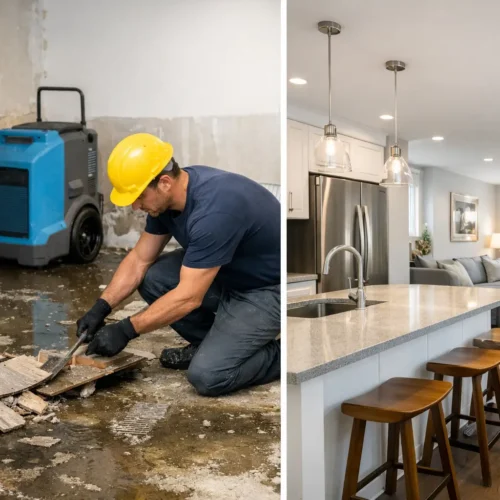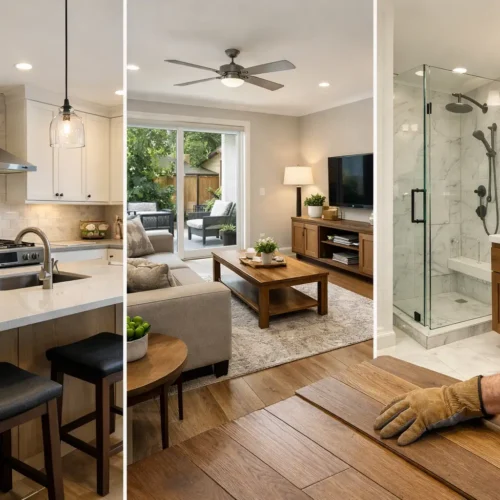








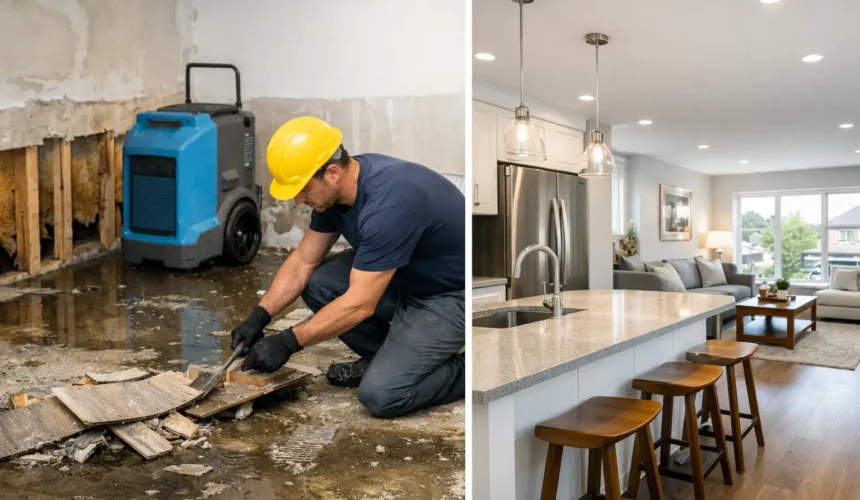
The room should feel whole again. Not patched. Not suspiciously new in one corner and quietly compromised in another. Real water damage reconstruction GTA projects are about restoring confidence in the space – how it looks, how it performs, and how it holds up six months after everyone else has packed up.
That is where most rebuilds go sideways. Drying gets handled. Demolition gets done. Then the reconstruction phase is treated like standard renovation work, when it is anything but. A post-loss rebuild has hidden conditions, insurance documentation, code implications, sequencing pressure, and finish decisions that need to align with what existed before and what the property needs now.
What water damage reconstruction in the GTA actually includes
Water damage is never just about what got wet. By the time reconstruction begins, the project has already passed through emergency response, mitigation, selective demolition, and drying. What remains is the part that owners care about most – putting the property back into service without creating a second wave of problems.
In a home, that may mean rebuilding a kitchen after a supply line failure, reframing and reinsulating basement walls after a flood, replacing flooring across connected rooms, restoring millwork, and making sure paint, trim, tile, and cabinetry work together rather than looking like mismatched repairs. In a commercial space, it may mean reopening offices, retail areas, or tenant interiors to a standard that supports operations, brand presentation, and code compliance.
That distinction matters. Reconstruction is not the cleanup crew staying longer. It is a coordinated build phase. It requires scope control, trade sequencing, material clarity, and a builder who understands that hidden moisture is only one part of the risk.
Why reconstruction fails after the drying is complete
Most owners assume the hard part is over once the moisture readings are down and the damaged materials are removed. In reality, that is when the project becomes easier to underestimate.
The first issue is incomplete scoping. A floor gets replaced, but the baseboards, door casings, transitions, and adjacent finish continuity were never documented. A ceiling gets closed, but insulation, vapor barrier conditions, and framing corrections were not captured properly. The result is predictable – change orders, delays, and visible inconsistencies.
The second issue is trade coordination. Water loss projects often compress timelines. Everyone wants the space back quickly. But fast and controlled are not the same thing. If framing corrections, insulation, drywall, cabinetry, flooring, and paint are not sequenced with discipline, small misses compound into expensive rework.
The third issue is a weak handoff between mitigation and rebuild. This is one of the most common failures in the industry. The drying contractor exits. The reconstruction team enters. Critical information gets lost in between. What was removed, what was saved, what was tested, what was approved, and what still needs review can become surprisingly unclear.
That lack of continuity is where a structured builder changes the outcome.
The rebuild starts with documentation, not demolition
A controlled reconstruction begins with a documented understanding of the loss condition and the desired finish condition. That sounds obvious. It rarely happens with enough rigor.
Before trades are mobilized, the scope should define what is being rebuilt, what is being replaced, what remains, and how transitions will be handled. If a hardwood floor runs through multiple connected areas, the decision is not just whether boards can be patched. It is whether the final result will read as intentional or repaired. If custom cabinetry was affected, the question is not simply whether boxes can be salvaged. It is whether door profiles, finish matching, layout integrity, and adjacent surfaces still make sense.
This is where Spartan Builders’ ClearScope™ approach becomes valuable. Reconstruction projects need written clarity before the first rebuild trade arrives. Materials, scope boundaries, and finish expectations have to be defined upfront. That reduces disputes later and protects the owner from a project drifting one missing detail at a time.
Water damage reconstruction GTA projects need design judgment too
Insurance restoration is often treated as a technical exercise. It is technical, but it is also visual. The rebuilt space has to make sense as a whole.
A water-damaged main floor does not exist in isolation. Flooring selections affect sightlines into adjacent rooms. Rebuilt bathroom walls affect tile alignment, trim reveals, lighting placement, and fixture reinstallation. Basement reconstruction may create an opportunity to improve layout flow, storage integration, or material resilience in a way that better suits the property long term.
This is where owners get frustrated with basic contractor thinking. They do not want a room that is merely back. They want a room that feels correct. In higher-value homes and professionally designed commercial interiors, that standard is not optional.
Good reconstruction respects the original intent of the space. Great reconstruction improves weak points without introducing visual noise. That takes more than trade labor. It takes design sense, technical control, and restraint.
Code, compliance, and hidden corrections
Not every water loss triggers major code upgrades, but some do. It depends on the extent of demolition, the building type, the age of the property, and what is uncovered once finishes are removed.
Insulation may need correction. Framing may reveal prior deficiencies. Fire separations in mixed-use or multi-unit conditions may need proper restoration. Commercial spaces may require documented coordination to ensure the rebuilt interior aligns with occupancy needs and building requirements.
This is one reason reconstruction should never be priced or managed as if it were just cosmetic replacement. Once walls and ceilings are opened, the builder has a responsibility to rebuild correctly, not just quickly. Owners benefit from that discipline even when it adds complexity, because unresolved issues tend to resurface at the worst possible time – after the claim is closed, after the tenants return, after the furniture is back in place.
The trade network matters more after water damage
On a standard renovation, owners can sometimes absorb a little inefficiency. On a loss project, poor trade performance hits harder. The property is already disrupted. Timelines matter. Clean handoffs matter. Documentation matters.
A reconstruction team needs trades who understand post-loss conditions, not just general construction tasks. Drywall repairs in a flood-affected basement are one thing. Rebuilding a kitchen after water spread into cabinetry, flooring, wall assemblies, and adjacent finishes is another. Commercial reconstruction after a leak above tenant improvements requires even tighter coordination, especially when reopening schedules are tied to revenue and occupancy.
That is why a vetted network is not a marketing phrase. It is operational protection. Spartan Builders’ Builders Plug™ model exists for this reason – licensed, insured trades with standards, accountability, and no improvisation disguised as experience.
Residential and commercial water loss are not the same job
The core principles overlap, but the priorities shift.
In residential work, the emotional side is larger. Families are living through disruption, temporary relocation, finish decisions, insurance conversations, and the stress of seeing familiar spaces dismantled. The builder has to restore function and trust at the same time.
In commercial work, downtime, compliance, and brand continuity usually lead. The space may need phased work, after-hours coordination, tighter site controls, or faster procurement decisions to support reopening. A retail store, office, or restaurant cannot be rebuilt with a vague timeline and a loose scope. That is not inconvenience. That is operational risk.
In both cases, the common requirement is structure. Not more promises. More control.
How a disciplined reconstruction process protects the final result
The best water damage reconstruction GTA projects feel surprisingly calm to the owner, even when the technical scope is significant. That usually means the builder has already done the hard work behind the scenes.
A disciplined process starts with a complete scope. It moves into realistic sequencing. It tracks procurement, milestones, inspections, and trade dependencies. It keeps communication active so the owner is never forced to guess what happens next. And it treats finish restoration with the same seriousness as structural corrections.
That is the logic behind The Spartan System™. Reconstruction is a chain. If one link is unclear, the entire project suffers. Structured delivery keeps the project readable from start to finish, which is exactly what owners need after the disruption of a flood or major leak.
There is also a practical advantage to this level of control. It reduces the common friction points that make restoration work drag on – missing materials, unclear approvals, overlapping scopes, and rework caused by poor sequencing. The owner sees one project. The builder has to manage fifty moving parts underneath it.
What owners should expect before reconstruction begins
Before the rebuild starts, the owner should understand the scope, the finish intent, the timeline logic, and the decision points that could affect schedule or outcome. If those items are vague, the project is not ready.
That does not mean every hidden condition can be predicted. Water damage work always carries some uncertainty. But uncertainty should be managed openly, not discovered carelessly. There is a difference between a legitimate concealed issue and a project that was never fully thought through.
A serious reconstruction partner will set expectations clearly. They will explain where matching may be straightforward and where full replacement may create a better result. They will separate what must be corrected from what is optional. They will document enough detail that the rebuild stays aligned with the owner’s goals instead of drifting under field pressure.
When water damage disrupts a property, people want speed. What they actually need is control. Fast is useful. Clear is better. A rebuilt space should not remind you of the loss every time you walk into it. It should feel settled, resolved, and fully yours again.