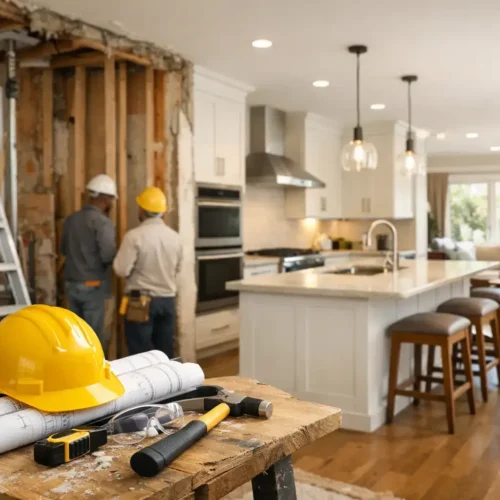










Picture the finished space first. The kitchen works the way your day works. The addition feels like it always belonged. The office opens on time and reflects the brand it was meant to carry. That is the outcome clients are buying. And yet, one of the first fears behind any project is why renovation budgets go over.
The short answer is not bad luck. It is usually a failure of definition, sequencing, and control. Costs rise when the work was not fully documented, when selections were not finalized, when site conditions were assumed instead of verified, and when decisions are made too late for the schedule to absorb them. Most overruns are built into the project long before demolition starts.
Why renovation budgets go over before construction begins
The biggest cost problem in construction is not overspending. It is under-defining the project.
A renovation budget often starts as a hopeful number attached to a broad idea. New kitchen. Better basement. Expanded office. Full home remodel. But broad ideas do not get priced accurately. Actual pricing depends on exact scope, exact materials, exact site conditions, and exact sequencing. If any of those are vague, the initial number is only a placeholder.
This is where many projects go sideways. Clients believe they received a budget for the job they want. In reality, they received a budget for the parts that were described clearly enough to price. The gap between those two things is where overruns begin.
A builder cannot control what was never defined. If cabinetry details are still open, if tile ranges are still broad, if structural assumptions have not been confirmed, or if permit-related requirements are not fully integrated into the plan, the budget carries hidden exposure. It may look complete on paper. It is not complete in execution.
Scope gaps are the real budget killer
Most people assume renovation budgets go over because materials got expensive or because a contractor added charges midway through the job. That can happen, but it is rarely the root cause. The deeper issue is missing scope.
A missing scope item is anything the project needs but the budget did not fully include. Sometimes it is obvious in hindsight, like relocating a drain for a redesigned layout or adding framing changes after opening walls. Sometimes it is quieter, like trim transitions, substrate preparation, delivery logistics, temporary protection, disposal, finishing details, hardware upgrades, or code-driven corrections triggered by the renovation itself.
Individually, these items can seem small. Combined, they move the budget fast.
In residential work, this often shows up when homeowners finalize design decisions after pricing instead of before pricing. In commercial work, it appears when operational needs, landlord requirements, or compliance details are not fully coordinated during planning. Different project types. Same result. The estimate was never pricing a fully locked project.
The cost of allowances and assumptions
Allowances are not inherently bad. They are useful when a selection is genuinely not finalized yet. But too many allowances create a budget that looks firm while behaving like a draft.
If the bathroom tile allowance was based on a mid-range product and the final selection is a premium material with different installation requirements, the budget changes. If lighting, millwork finishes, appliance specs, or specialty fixtures were assumed instead of selected, the same thing happens. The issue is not that the client upgraded. The issue is that the budget was asked to perform like a fixed number before the project was fully specified.
Assumptions create the same instability. If the build team assumes level floors, standard framing conditions, or uncomplicated tie-ins to existing conditions without proper verification, those assumptions eventually meet reality on site. Reality always wins.
The wall opens, and the truth arrives
Renovation work is different from new construction because you are not building in a clean, predictable environment. You are entering an existing structure with history.
Behind walls and above ceilings, there may be previous repairs, out-of-date framing, hidden moisture damage, structural modifications, incomplete insulation, or old work that does not align with current code requirements. In older properties across the Greater Toronto Area, this is common. Not dramatic. Just common.
That does not mean every renovation should be padded with inflated contingency. It means unknowns should be acknowledged honestly and investigated where possible before work begins. Some conditions can be verified through site review, design development, and selective opening. Some cannot. A disciplined builder distinguishes between what is known, what is likely, and what remains truly unknown.
Clients do better when that distinction is made early. Surprises are not eliminated by pretending they will not happen. They are reduced by documenting risk before it becomes cost.
Late decisions are expensive decisions
Time and money are tied together on a renovation. When one moves, the other usually follows.
A client changing a finish is not always a problem. A client changing a layout after framing, cabinetry, or rough-ins are coordinated usually is. The later a decision lands, the more trades it touches. Materials may need to be reordered. Install dates may shift. Work may need to be undone and redone. Even a smart design revision can become an expensive field change if it arrives at the wrong moment.
This is one of the least understood reasons why renovation budgets go over. People think in terms of material cost difference. The project feels the change in labor, sequencing, schedule disruption, and coordination strain.
That is why strong pre-construction matters so much. It creates a point where design decisions become real commitments, not moving targets. Once the build starts, clarity saves money.
Poor coordination creates hidden cost
A renovation does not fail because one trade did poor work. It usually fails because no one controlled how the entire sequence fit together.
Budget overruns often come from coordination breakdowns: materials arrive out of order, drawings conflict with site conditions, one trade finishes before another prerequisite is complete, field measurements happen too early, inspections are not aligned with schedule, or communication is reactive instead of structured. None of this looks dramatic from the outside. It still costs money.
This is where process separates professional builders from project chaos. Scope documentation, specification control, vetted trades, milestone tracking, and real communication are not administrative extras. They are budget protection.
At Spartan Builders, that is exactly why systems like ClearScope™, The Builders Plug™, and The Spartan System™ exist. Not to make construction sound polished. To make it controlled. A well-run project costs what it should cost because the team knows what is being built, who is building it, when each phase happens, and what decisions are still open.
Cheap numbers are often expensive projects
Some budgets go over because the original price was never realistic.
This is not always intentional. Sometimes the number was assembled too quickly from partial information. Sometimes important categories were softened to keep the total attractive. Sometimes the builder priced the visible work and left the supporting work too thin. The result is the same: the project starts with a number that cannot carry the actual scope.
Clients who care about long-term value usually sense this. A price can feel low without feeling credible. That instinct is worth listening to.
A serious budget should show discipline. It should reflect defined scope, realistic production conditions, documented material expectations, and enough operational structure to deliver the work without improvisation becoming the business model.
How to keep a renovation budget from drifting
The fix is not guesswork and it is not blind contingency. It is better planning.
The most reliable budgets are built after the scope is documented in detail, the design intent is resolved, critical selections are made, site conditions are reviewed carefully, and the construction sequence is mapped with real trade coordination in mind. This takes more effort upfront. It also prevents the far more expensive version of the project where answers are developed in the field.
For homeowners, this means resisting the urge to treat pre-construction as a formality. For commercial clients, it means aligning operations, approvals, compliance, and brand execution before the schedule gets compressed. For design professionals, it means working with a builder who can protect specification integrity instead of pricing around it.
There is always a balance to strike. Not every unknown can be eliminated. Not every finish decision must happen on day one. But the major drivers of cost should be resolved before trades mobilize. That is the line that matters.
A renovation budget should not be a hopeful starting point. It should be a controlled plan tied to a defined outcome. When that happens, the project feels different from the beginning. Calmer. Clearer. More precise.
And that is usually the best signal of all. When the work is organized before it starts, the budget has a far better chance of staying where it belongs.