







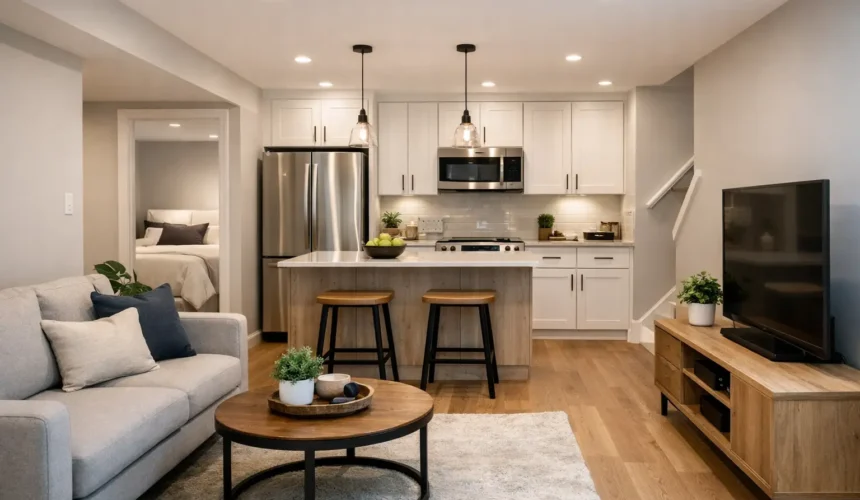
Picture a basement that no longer feels like a basement. Full-height doors. Warm, even lighting. A kitchen that belongs in the main house, not below it. A private entrance that feels intentional. The right basement apartment conversion example does more than add square footage. It shows how design, code, and construction discipline come together to create a legal, livable space that stands on its own.
That is where most projects separate. Not at framing. Not at paint. At the point where vision either gets translated into a complete plan, or gets left to be figured out trade by trade. A basement apartment only works when the space is planned as a real home from day one.
What a strong basement apartment conversion example actually shows
A useful example is not a before-and-after photo set with a nice backsplash and staged furniture. It is a finished suite where every decision supports function, compliance, and long-term performance.
Start with the layout. The best basement apartments do not feel like leftover space divided into rooms. They feel composed. The entry makes sense. The kitchen has breathing room. The bathroom is placed where plumbing and structure support it without compromising the rest of the plan. The bedroom has proper egress, privacy, and storage. Ceiling bulkheads are controlled, not scattered randomly across the space.
Then there is the invisible work. Sound separation between floors. Fire-rated assemblies where required. Moisture management that protects finishes over time. Mechanical planning that serves both levels properly. This is the part homeowners rarely see in inspiration photos, but it is the part that decides whether the suite feels solid and complete or temporary and compromised.
A real basement apartment conversion example should show both layers. The visible outcome and the hidden structure behind it.
A realistic basement apartment conversion example
Imagine a detached home with an unfinished lower level in the Greater Toronto Area. The owners want a self-contained apartment for extended family. Privacy matters. So does comfort. They do not want the lower level to feel secondary.
The starting condition is common. The basement has decent square footage but uneven ceiling conditions, a mechanical room in the wrong place, limited natural light, and no clear entry sequence. Left alone, it would produce the kind of apartment people tolerate rather than enjoy.
The solution begins with planning, not demolition. The suite is organized around a central living and kitchen zone so the largest open area gets the most light. The bedroom is placed along the exterior wall with a compliant egress window. The bathroom is tucked near existing service lines, but not in a way that pinches the hallway or forces awkward door swings. Storage is built in where the structure allows it, rather than added as an afterthought.
The kitchen is compact but not stripped down. Full-size appliances fit because the cabinetry is designed around exact dimensions, not guessed on site. Upper cabinets stop where ceiling conditions demand it, and the transitions are intentional. Lighting is layered so the room feels calm, not overlit.
The entrance is treated like architecture, not access. Exterior grading, drainage, stair geometry, head clearance, door placement, and weather protection all matter. When the resident arrives home, the first impression should be arrival, not descent.
Sound control is addressed early. That means insulation strategy, resilient mounting where needed, and careful sealing around penetrations. Without that, even a beautiful suite can feel exposed. A basement apartment is private only if it sounds private.
This kind of example works because it respects the suite as a complete environment. Not just a renovated basement.
Why layout matters more than finishes
Finishes get attention because they photograph well. Layout determines whether the apartment lives well.
A poor layout usually shows up in small irritations that never go away. A refrigerator door that blocks circulation. A bathroom door that opens into a narrow hall. A living room with no logical wall for furniture. A bedroom closet that steals too much floor area. None of these decisions seem dramatic on their own. Together, they define the experience of the home.
In a basement apartment, layout pressure is higher because the constraints are tighter. Ceiling heights, beam runs, foundation walls, and mechanical zones all shape the plan. This is why generic contractor thinking falls short. You cannot simply divide square footage and expect the result to work. The apartment has to be designed around the structure, the code path, and the daily use pattern at the same time.
That takes coordination. It also takes restraint. Sometimes the smartest move is a slightly smaller kitchen that gives the living area better proportion. Sometimes it is a pocket door that solves a clearance issue. Sometimes it is relocating a utility zone to recover an entire wall of usable space. Good planning is rarely loud. It is precise.
Code compliance is part of the design
Homeowners often talk about legal basement apartments as if legality sits outside the design conversation. It does not. Code shapes the space from the beginning.
Egress requirements affect bedroom placement and window strategy. Fire separation affects ceiling and wall assemblies. Smoke alarms, exits, ventilation, and life safety requirements influence the entire plan. Ceiling clearances and stair conditions can also become defining constraints.
This is where many projects lose control. Someone starts with a finish vision, then tries to force compliance into it later. That usually leads to redraws, compromises, or expensive corrections. The stronger path is to build the compliance framework into the concept from the first draft.
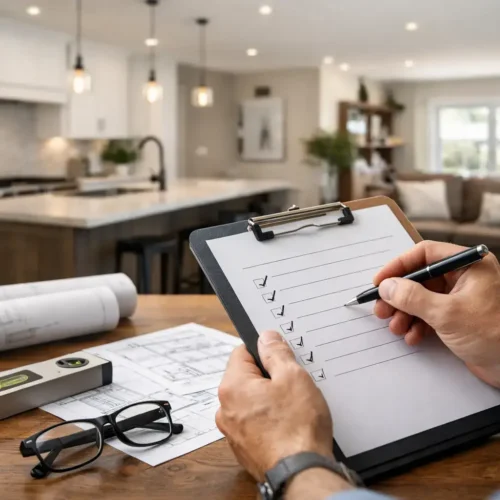
That is also why documentation matters. A basement apartment is not a room refresh. It is a coordinated build that needs scope clarity before trades arrive. The sequence matters. The details matter. If the team is improvising halfway through, the project is already drifting.
What separates a polished suite from a patched-together one
The difference is usually not luxury. It is resolution.
A polished suite has consistent floor transitions. Bulkheads are aligned. Door heights are intentional. Trim details make sense. The bathroom fan is placed where it performs well without disrupting the ceiling composition. Access panels exist where needed, but they are not dropped randomly into the middle of a finished wall. Every visible element suggests that someone thought through the whole space.
A patched-together suite often reveals itself at the edges. Mismatched ceiling planes. Strange soffits. Fixtures placed to work around field mistakes. Cabinet fillers that look accidental. Rooms sized by leftover dimensions instead of lived experience.
This is why process-led construction matters. A disciplined builder does not wait for surprises to appear. They reduce them through scope documentation, measured planning, and trade coordination before the project enters the build phase. Spartan Builders approaches this through systems built to prevent the industry’s most common failures – unclear scope, weak coordination, drifting schedules, and expensive mid-project decisions.
Design choices that help a basement feel like a real home
The best basement apartments borrow less from the idea of a basement and more from the standards of the main floor.
Natural light should be amplified, not fought. That often means lighter finishes, but not sterile ones. Warm wood tones, balanced contrast, and thoughtful reflectivity help the space feel grounded. Artificial lighting should be layered across ambient, task, and accent zones so rooms read with depth.
Ceilings deserve special discipline. In lower-level spaces, every inch matters visually. Clean alignment of bulkheads and fixtures can make the ceiling feel calmer and higher than it is. Flooring should run continuously where possible to avoid visual breaks. Bathrooms can carry stronger material contrast because they are enclosed, but the main living area benefits from continuity.
Storage is another separator. A basement apartment that lacks integrated storage starts to feel temporary very quickly. A coat closet near the entrance, bedroom storage that does not consume the room, and well-planned kitchen cabinetry all add stability to the living experience.
The right example is not just attractive. It is repeatable.
That is the standard worth using. Not whether a project looks good in one finished photo, but whether the logic behind it can be trusted from planning through completion.
A strong basement apartment conversion example proves that the result was not luck. It shows that the layout was intentional, the code path was understood, the details were coordinated, and the finished space was built to perform as well as it looks. That kind of project gives homeowners something more valuable than extra square footage. It gives them certainty.
If you are evaluating your own basement, look past the finishes first. Ask whether the space can be planned as a true home, with privacy, compliance, and architectural clarity built in from the start. That is where a good project begins. And it is usually where a great one is decided.