








Key Takeaways
- A structural wall removal contractor ensures safe load-bearing while intentionally improving the space, not just removing a wall.
- Proper planning and coordination prevent complications, ensuring that structural changes support the overall renovation.
- Evaluate contractors by asking how they will manage documentation, structural reviews, and potential unknowns during the project.
- Expect clear communication throughout construction, including progress milestones and any anticipated impacts on the project.
- Successful wall removal results in a seamless, well-designed space rather than just an open area, requiring both structural intelligence and design discipline.
Picture the finished space first. The kitchen finally opens to the dining area. Sightlines stretch across the main floor. Light moves farther. Traffic flows better. The home feels calmer, larger, and more valuable without adding a single square foot.
That outcome does not start with demolition. It starts with control.
If you are hiring a structural wall removal contractor, you are not buying the act of taking a wall down. You are buying the judgment, documentation, engineering coordination, sequencing, and execution that make the new space feel effortless when it is anything but. This is where many projects go sideways. The wall comes out. Then the surprises begin.
What a structural wall removal contractor actually does
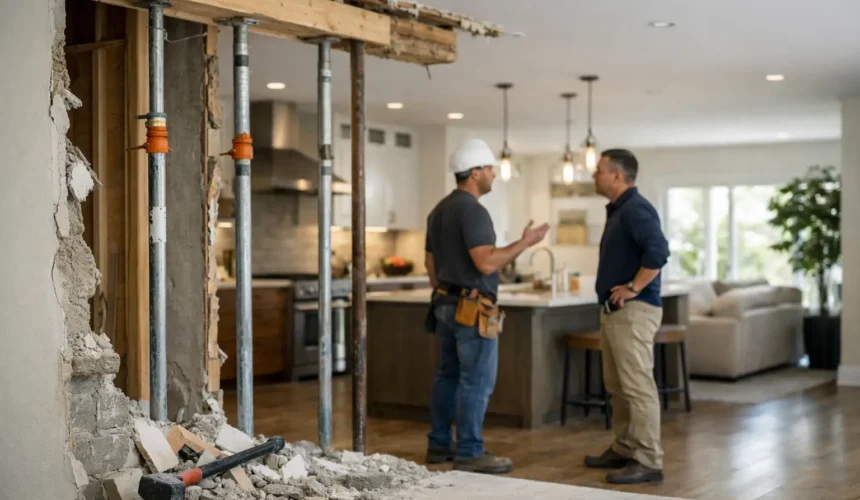
A true structural wall removal contractor is not just a crew with shoring posts and a disposal bin. The real job is to carry the load safely while improving the space intentionally.
That means confirming whether the wall is load-bearing, understanding what sits above and below it, coordinating the structural design, planning temporary support, organizing permits and inspections where required, and rebuilding the surrounding space so the final result looks resolved rather than patched together.
The best contractors think beyond the beam. They think about ceiling transitions, flooring continuity, millwork alignment, lighting layouts, bulkheads, finishes, and how the new opening changes the entire room. Structural work and design work are connected. Treating them as separate problems is one of the fastest ways to get an expensive compromise.
Why structural wall removal goes wrong so often
The failure is rarely dramatic. It is usually procedural.
A contractor prices the demolition before the structure is fully understood. Engineering gets handled late. Hidden conditions appear after opening the ceiling. LVL sizing changes. Posts land in awkward places. Mechanical lines need rerouting. Inspections stall the schedule. The opening is technically complete, but the room looks like it was forced into submission.
This is the difference between a trade-led approach and a system-led one.
A trade-led approach focuses on the task. Remove the wall. Install the beam. Patch the area. A system-led approach defines the full scope before work begins, coordinates the design intent with structural reality, and sequences every moving part so the wall removal supports the larger renovation instead of disrupting it.
For homeowners, that means fewer surprises and far less chasing. For commercial clients, it means less operational disruption and tighter control of schedule risk. For architects and designers, it means the built result stays aligned with the plan.
How to evaluate a structural wall removal contractor
The right question is not, “Can you remove this wall?” Many contractors will say yes. The better question is, “How do you control everything that follows?”
A qualified contractor should be able to explain how the scope will be documented before demolition starts, how structural review will be coordinated, how temporary support will be handled, what permit path applies, what finish work will be affected, and how schedule sequencing will protect the rest of the project.
They should also be able to speak clearly about unknowns. Not vaguely. Clearly.
Because sometimes the wall is carrying more than expected. Sometimes a flush beam is possible. Sometimes a dropped beam is the right move. Sometimes the desired opening width changes after engineering review. Sometimes the cleanest design choice adds complexity elsewhere. Serious builders do not hide those trade-offs. They explain them early, while there is still room to make smart decisions.
Structural wall removal contractor responsibilities before any work begins
The most valuable part of the project often happens before the first cut.
A disciplined contractor studies the existing structure, reviews available plans if they exist, coordinates field verification, and maps the impact of the removal across adjacent systems and finishes. That up-front work is what separates a controlled renovation from a chain reaction.
In many projects, removing one wall affects far more than one wall. Ceiling planes change. Flooring needs to be blended or replaced. Cabinet layouts may need revision. Lighting can shift from room-based to open-concept zoning. In older homes across the Greater Toronto Area, existing framing conditions can also vary enough that assumptions become expensive.
This is why documentation matters so much. At Spartan Builders, that is exactly why we use ClearScope™ – to define the work in full before the site turns active. Structural changes are too interconnected to be managed from loose notes and verbal assumptions.
Design matters as much as engineering
A wall can be removed safely and still be removed poorly.
You see it when the new beam creates an awkward drop that was never integrated into the design. You see it when a post lands in the middle of a sightline. You see it when the kitchen island no longer aligns with the opening, or when the room gains openness but loses order.
A strong structural wall removal contractor understands that the beam is not the finish line. The room is.
That requires design judgment. Not decoration. Judgment.
Should the beam be concealed or expressed? Is a dropped section acceptable if it preserves budget elsewhere, or does the architecture demand a flush finish? Should the opening be widened now to avoid a second round of work later? Does the new layout improve circulation, or does it simply make the room feel less defined? These are not demolition questions. They are planning questions. They determine whether the project feels intentional once complete.
Residential and commercial projects require different thinking
The structural principles may be similar, but the project pressures are not.
In a home, the focus is usually daily life. How the family moves through the space. How the kitchen connects to gathering areas. How natural light and visibility improve. The work needs to protect both the structure and the experience of living there.
In a commercial setting, the opening may support customer flow, operational visibility, accessibility, or a new interior layout. Timing becomes sharper. Permit paths may be more layered. Inspections can carry greater business impact. The right contractor adjusts the planning model to the environment rather than treating every structural opening like the same job with different paint.
What clients should expect during construction
Even well-planned structural work is invasive for a short period. There will be temporary supports. There may be noise, dust control measures, inspection windows, and moments where progress looks slower because critical sequencing is happening behind the scenes.
That is normal.
What should not be normal is confusion.
You should know what phase the project is in, what milestone has been reached, what is waiting on approval or inspection, and what happens next. Communication is not a courtesy on structural work. It is part of risk control. The more complex the intervention, the more disciplined the reporting needs to be.
That is where a vetted trade network and structured project delivery matter. The Builders Plug™ and The Spartan System™ exist for exactly this reason – to keep structural work coordinated, accountable, and moving in the right order.
Red flags to watch for
If a contractor is casual about permits, vague about engineering, dismissive of finish impacts, or overly confident before opening conditions are verified, pay attention.
If they treat the wall removal as an isolated line item rather than part of the broader renovation, pay attention.
And if the proposal leaves too much undefined, that uncertainty does not disappear when construction begins. It usually becomes your problem later.
The strongest contractors are not the ones who promise the easiest path. They are the ones who can define the right path with enough clarity that you know what is being built, how it will be executed, and where decisions may still need to be made.
The real result is not an open wall
The real result is a space that feels like it was always meant to be this way.
That takes structural intelligence, design discipline, and project control working together from the start. When those pieces are aligned, wall removal stops being a risky interruption and becomes what it should be – a precise move inside a larger vision for the property.
If you are considering this kind of change, choose the team that can see past the beam. The best spaces always start there.
Estimated reading time: 7 minutes