






Key Takeaways
- An office fit out contractor transforms spaces into functional business environments by coordinating complex tasks like demolition, layout execution, and life safety requirements.
- Choosing the right contractor is essential to maintain design intent, avoid delays, and ensure business continuity during the fit-out process.
- Effective contractors clarify project scope, manage material selections, and document decisions to prevent common pitfalls like incomplete drawings and scheduling issues.
- Communication, transparency, and collaboration with architects and designers are crucial for successful office projects; contractors need to integrate these roles effectively.
- A well-executed office fit-out positively impacts business performance by creating environments that enhance workflows, trust, and operational focus.
Estimated reading time: 7 minutes
A finished office should feel inevitable.
Not improvised. Not patched together. Not like a lease obligation dressed up with fresh paint and new flooring. The right space supports focus, reflects the brand, and lets people move through the day without friction. Clients notice it. Staff feel it. Leadership sees it in how the business operates inside the walls.
That result does not come from hiring trades one by one and hoping they align. It comes from choosing the right office fit out contractor.
What an office fit out contractor actually does
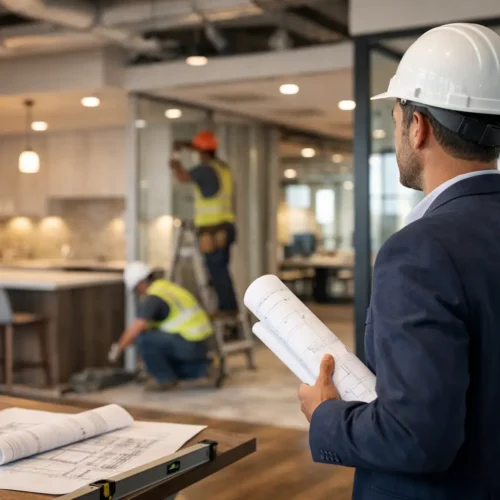
An office fit out contractor turns an empty shell or outdated workplace into a functioning business environment. That sounds simple until you look at what has to be coordinated behind the scenes.
A real fit-out is not just finishes. It involves demolition, framing, layout execution, millwork, lighting coordination, life safety requirements, accessibility, permits, scheduling, site supervision, and close control over how each trade hands work to the next. If one decision is vague at the front end, the effect ripples through the entire job.
That is why the contractor matters so much. You are not hiring someone to install materials. You are hiring someone to control the sequence, protect the design intent, and move the project from concept to completion without drift.
In office environments, that control is even more critical. Unlike some commercial spaces, offices often need to balance aesthetics, acoustics, privacy, circulation, technology access, meeting areas, and employee comfort at the same time. A contractor who only thinks in terms of construction will miss half the assignment.
The difference between construction and fit-out execution
Many builders can renovate a room. Fewer can execute a commercial interior that has to perform on day one.
An office fit out contractor works at the intersection of design, engineering logic, code compliance, and site discipline. The best ones understand that every office project has two deliverables. The first is the physical space. The second is business continuity. If the build disrupts operations, delays occupancy, or creates confusion around approvals and finish decisions, the project is already underperforming.
This is where trade-offs start to matter. A fast schedule may be possible, but only if the scope is fully documented early. A highly customized office can look exceptional, but custom work demands tighter lead-time control. Open-plan layouts may feel modern, but they can create acoustic issues if not handled properly. There is no single correct formula. There is only the right solution for how your team works.
That is why experienced fit-out contractors ask better questions at the beginning. How many enclosed rooms are truly needed? Where does focused work happen? Which spaces need acoustic separation? What has to be built for client impression, and what has to be built for daily performance? Good answers save time later.
What to look for in an office fit out contractor
If you are evaluating firms, the real test is not who sounds confident in a meeting. It is who can reduce uncertainty before construction begins.
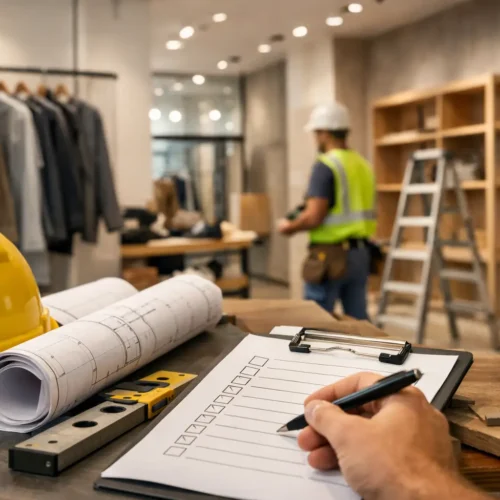
A strong office fit out contractor should be able to show how they define scope, how they manage trade coordination, how they document material selections, and how they control milestones. These are not administrative details. This is the job.
Too many projects fail in predictable ways. The drawings are incomplete. Finish selections are still floating after the site is active. One trade arrives before another is done. Pricing changes because the original scope left room for interpretation. The client spends the project chasing answers instead of making decisions.
The right contractor closes those gaps early.
That means written scope documentation. It means detailed material specification before site activity ramps up. It means permit and code awareness built into planning, not treated as an obstacle later. It means a schedule that reflects actual sequencing instead of optimism.
At Spartan Builders, that is exactly why we use ClearScope™ to define the project before a single trade steps in, The Builders Plug™ to deploy vetted licensed and insured trades, and The Spartan System™ to manage sequencing, milestones, and communication from start to finish. The value is not more paperwork. The value is control.
Why office projects go sideways
Most office fit-outs do not fail because the idea was weak. They fail because the execution path was loose.
Commercial clients are often juggling leases, operations, staffing decisions, furniture procurement, IT coordination, and reopening timelines while the build is underway. If the contractor cannot lead with structure, every other moving part becomes harder.
One common issue is a fragmented team. The designer may have a clear vision. The tenant may know how the business needs to function. But if the contractor is not translating those goals into precise site instructions, details get lost in the handoff.
Another issue is false simplicity. An office may look visually clean, but the work behind it can be highly technical. Glass partitions, custom reception desks, integrated lighting, accessibility clearances, sound management, and shared services all require planning. A contractor who prices quickly without fully defining those items is often passing risk forward.
Then there is schedule compression. Sometimes it is necessary. Lease dates are real. Move-ins are real. But speed without documentation usually creates rework, and rework is where timelines collapse. The best office fit out contractors know when to accelerate and when to slow the front end down to protect the whole project.
Questions worth asking before you sign
You do not need a contractor who gives the most polished pitch. You need one who can answer hard questions clearly.
Ask how scope gaps are prevented. Ask who is responsible for material tracking. Ask how site decisions are documented. Ask what happens when an existing condition on site differs from the plan. Ask how closeout is handled, including deficiencies, inspections, and final turnover.
You should also ask how they work with architects, designers, and engineers. Office projects often involve multiple decision-makers, and friction between disciplines can slow everything down. A dependable contractor does not treat consultants as separate from the build. They coordinate with them to protect the final result.
And ask about communication cadence. Not vague promises. Actual structure. Weekly reporting, milestone reviews, approval tracking, issue logs. Office clients do not need more noise. They need visibility.
When fit-out quality shows up in business performance
A well-executed office is not just nicer to look at. It changes how the business feels to the people inside it.
Teams work better when layouts match real workflows. Clients trust a company more when the environment feels deliberate. Leadership can focus on operations instead of unfinished details. Even simple things like sightlines, lighting balance, storage integration, and meeting room acoustics affect how people show up every day.
This is why fit-out decisions should not be reduced to surface-level style. The right office fit out contractor understands that the built environment shapes behavior. That is true whether you are creating a polished client-facing office, a collaborative team space, or a more private professional environment.
In the Greater Toronto Area, where commercial timelines are tight and expectations are high, that level of execution matters even more. Landlords, consultants, and business owners all need the same thing from the builder – clarity, control, and delivery.
Choosing the contractor who can carry the whole project
The right office fit out contractor brings more than labor to the site. They bring judgment.
They know when to challenge an assumption before it becomes a problem. They know how to preserve design intent while keeping construction practical. They know that the job is not done when materials are installed. It is done when the office is ready to support the business exactly as intended.
That is the standard worth holding.
Because a finished office should feel calm, precise, and ready from the moment you walk in. And the path to that result starts long before construction begins. It starts with a builder who can think clearly, document thoroughly, and execute without chaos.