







Estimated reading time: 12 minutes
Table of contents
- How to read a kitchen renovation budget breakdown
- Line-item cost deep dive: cabinets, countertops, appliances and fixtures
- Labor, trades and contractor fees you must budget for
- Where to spend for the most value and where to cut
- Build your itemized kitchen budget with sample allocations
- Download the budget template and use phased cost-review meetings to stay on budget
- Finish your kitchen renovation budget breakdown with confidence
Key Takeaways
- A kitchen renovation budget breakdown helps you plan by organizing costs into clear buckets and provides guidelines for allowances.
- Cabinetry takes up 29 to 35 percent of the budget; plan realistic allowances and compare quotes carefully.
- Labor and contractor fees vary significantly; budget between 17 to 55 percent for labor and confirm fee structures upfront.
- Use a downloadable budget template to facilitate discussions, maintain transparency, and adjust allocations as necessary.
- Prioritize quality in high-impact areas like layout and cabinetry, but consider cost-effective alternatives for less visible elements.
A kitchen renovation budget breakdown helps you stop guessing and start planning. It shows how to read spreadsheet buckets, use a cost estimator, and turn percentage rules into a practical budget you can act on. You’ll see the difference between line items and allowances, which costs tend to dominate, and simple rules for reallocating funds when a line item runs over.
How to read a kitchen renovation budget breakdown
Group costs into logical buckets so a spreadsheet is easy to scan and compare. Think of the budget as two layers: visible line items that contractors quote, and the allowances and contingency that support them. Recognizing that distinction makes it straightforward to compare estimates or plug numbers into a remodel cost calculator for a quick sanity check.
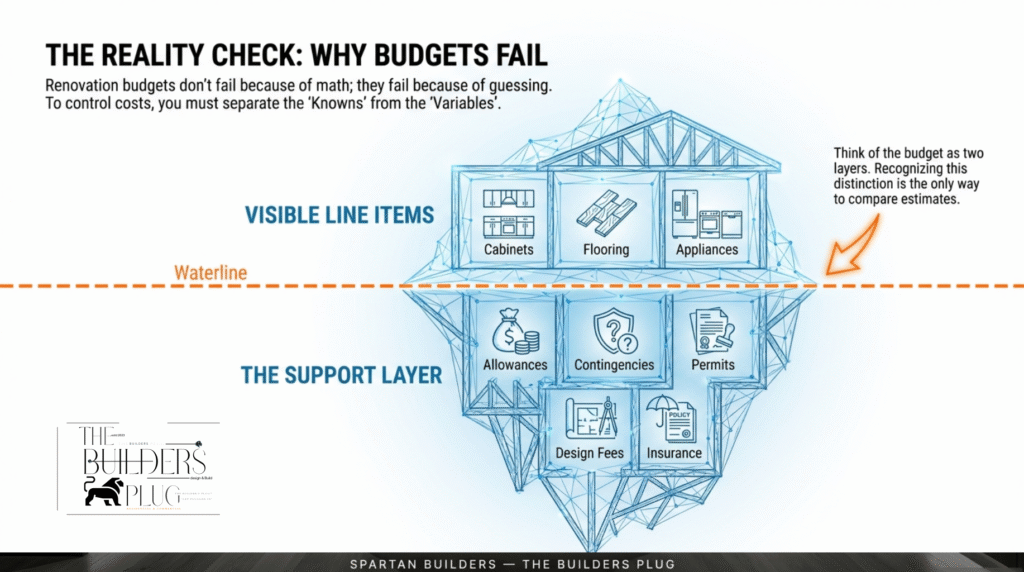
Common core line items are cabinetry, countertops, appliances, labor, plumbing fixtures, lighting and flooring. Soft but real costs include permits, design fees and general contractor overhead, which cover coordination, insurance and warranty. A line item is a defined scope with a firm price; an allowance is a placeholder for a selection you haven’t finalized, so treat allowances as shopping estimates rather than locked prices.
Use these allocation ranges as starting points; they shift with complexity, site conditions and selection level. Typical allocations are often in these bands:
- Cabinetry: 29 to 35 percent
- Labor and installation: 17 to 55 percent
- Appliances: 8 to 17 percent
- Countertops: 8 to 12 percent
- Lighting and electrical: 3 to 10 percent
- Flooring: 2 to 7 percent
- Plumbing and fixtures: 2 to 6 percent
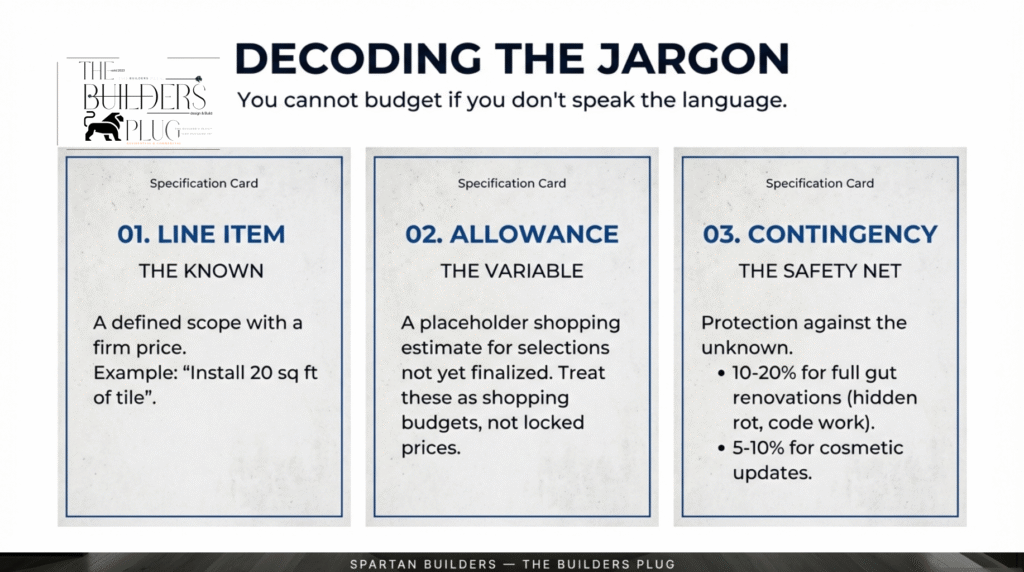
Those kitchen remodel budget percentages move with scope. Structural work, moving plumbing or changing layouts pushes labor toward the high end, while premium finishes raise cabinetry and countertop shares.
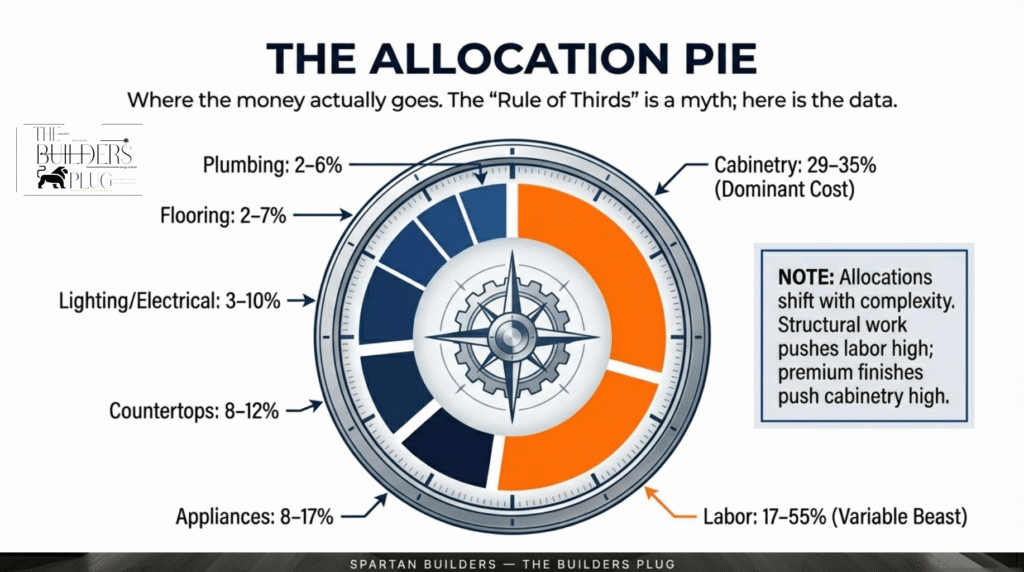
Finish allowances cover items such as tile or hardware, and contingencies protect against unknowns like hidden rot or unforeseen code work. For full renovations, use 10 to 20 percent contingency; for cosmetic updates, 5 to 10 percent is typical. Always document any reallocation of allowances so line-item costs stay transparent.
Line-item cost deep dive: cabinets, countertops, appliances and fixtures
Translate the kitchen renovation budget breakdown into per-unit numbers so material choices map directly to total cost. The ranges below let you plug values into a budget planner and set realistic allowances.
Cabinetry usually takes the largest share of a remodel. Stock cabinets typically run $100 to $400 per linear foot, semi-custom about $200 to $800, and custom from $500 to $1,200 or more per linear foot. For a typical 20 to 35 linear-foot kitchen, that translates to roughly $2,000 to $14,000 for stock, $4,000 to $28,000 for semi-custom, and $10,000 to $42,000 or higher for custom choices.
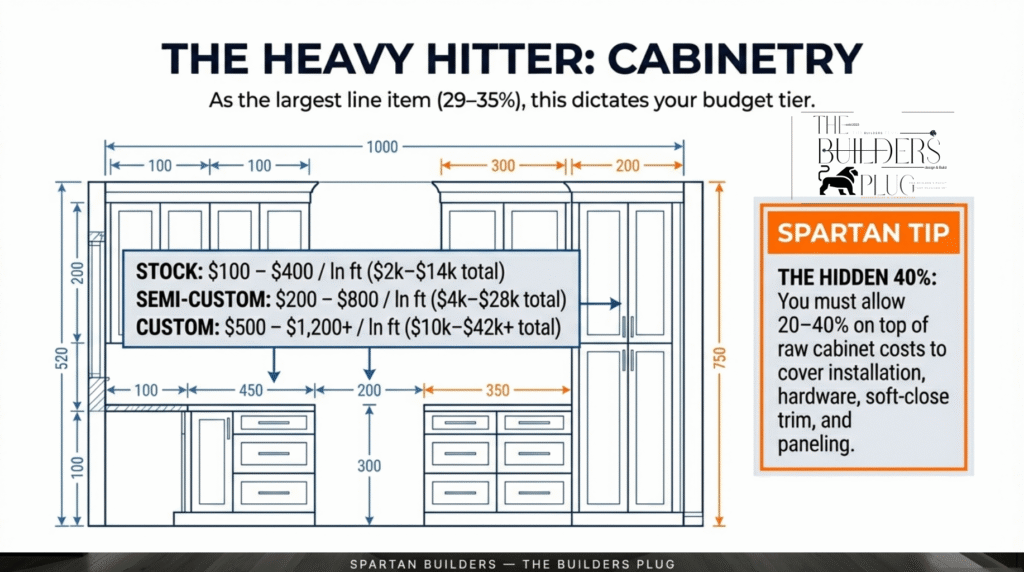
Allow about 20 to 40 percent on top of raw cabinet pricing for installation, hardware, soft-close drawers, paneling and trim. Multiply your cabinetry run by the per-foot cost and add that installation allowance to set a reliable cabinet budget.
Countertop pricing depends on material and finish: laminate $20 to $50 per square foot, solid surface $40 to $85, engineered quartz $50 to $150, and natural stone $60 to $250 or more depending on rarity. Seams, complex edge profiles and sink cutouts typically add $100 to $600 each, and integrated sinks or exotic stones can push costs higher. Countertops commonly take about 8 to 12 percent of the total budget, so place durable surfaces where daily use demands it and choose mid-range materials where visual impact is the priority.
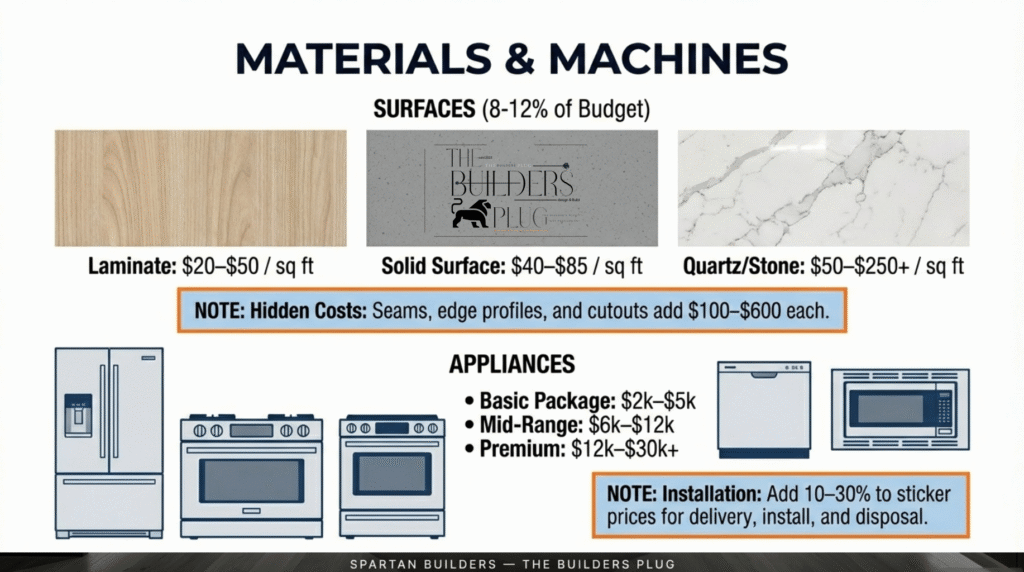
Appliance packages and fixtures span wide tiers. A basic appliance package often runs $2,000 to $5,000, mid-range $6,000 to $12,000, and premium $12,000 to $30,000 or more. Sinks typically cost $200 to $1,200 and faucets $150 to $900; plan for plumbing, venting and electrical labor and add installation, delivery and disposal fees, which commonly tack on another 10 to 30 percent to the sticker price.
Labor, trades and contractor fees you must budget for
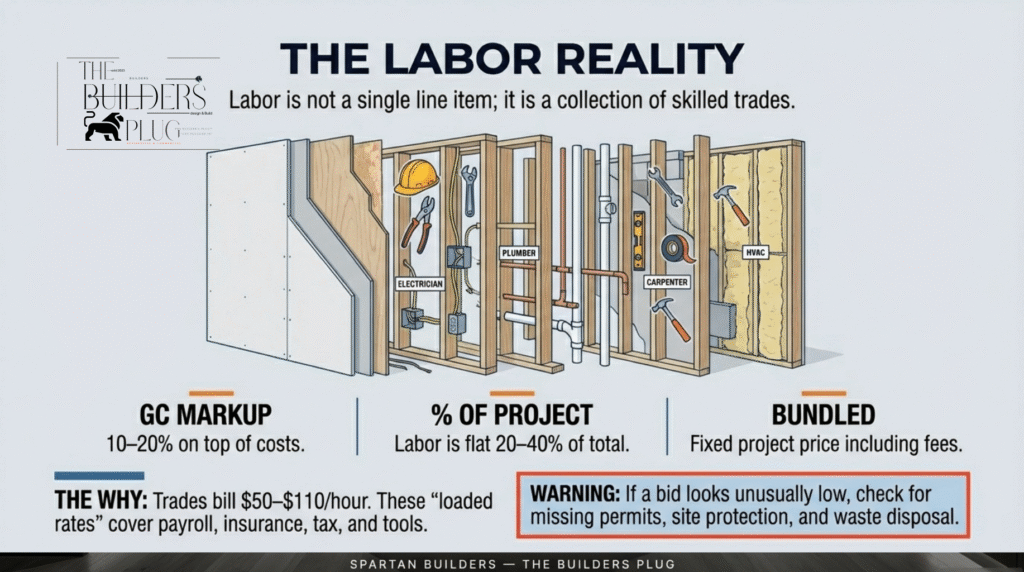
Labor is several overlapping charges, not a single line. Contractors commonly use one of three fee models: a general contractor markup of roughly 10 to 20 percent, labor expressed as a percent of the project (20 to 40 percent is common), or a bundled project price that includes fees. Trades often bill in hourly bands of about $50 to $110 per hour depending on skill and licensing; those loaded rates cover payroll burden, insurance, taxes and small tools. If a bid looks unusually low, check for missing items such as permits, site protection, disposal or warranty language to avoid surprise change orders.
Apply realistic task ranges to sanity-check estimates before signing. Small electrical or plumbing runs often cost in the low hundreds, while mid-level work such as tiling or cabinet installation typically runs in the low thousands. Whole-trade totals for a full renovation commonly fall between $5,000 and $45,000, and smaller projects show labor as a higher percentage of total cost.
Labor and material costs change with market and scale, so national averages are only a starting point. Expect higher rates in the GTA and other high-cost regions, and note that differences compound on larger projects or tight schedules.
Where to spend for the most value and where to cut
High-impact areas to invest in
Prioritize items that change daily life and hold resale value. A functional layout and quality cabinetry deliver the biggest returns by improving flow, storage and perceived value. Durable countertops and reliable appliances also pay off by reducing replacements and service calls while supporting resale appeal.
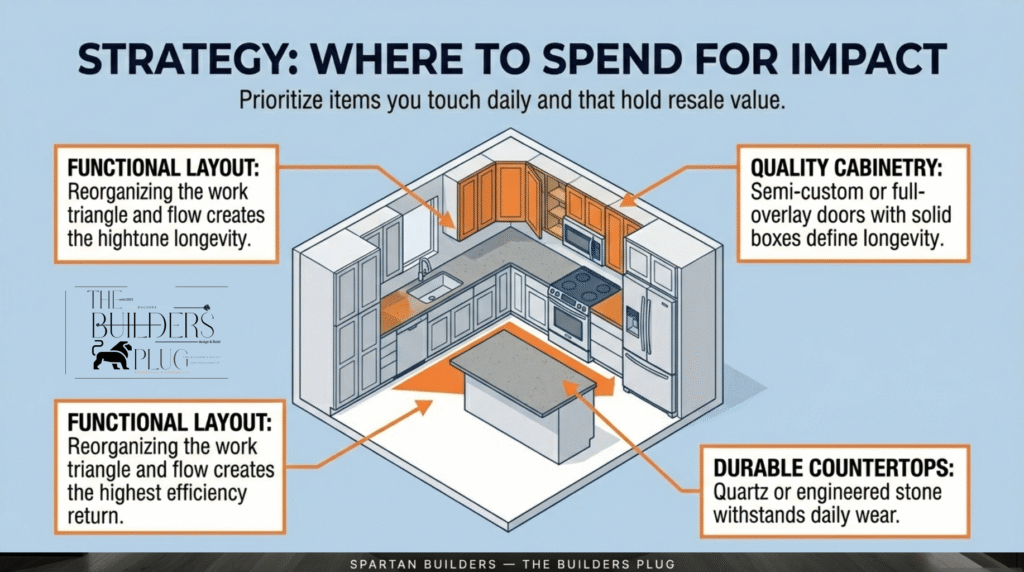
- Functional layout: reorganize the work triangle and storage for efficiency.
- Quality cabinetry: choose semi-custom or full-overlay doors with solid boxes.
- Durable countertops: quartz or engineered stone for daily wear.
- Good appliances: prioritize for heavy cooks or frequent entertaining.
Smart savings that keep the look
Save money without sacrificing style by choosing where the eye lands and where durability matters less. Structural changes deserve full spend, while visible finishes can be sampled and swapped for cost-effective alternatives that read high-end. Practical swaps include cabinet refacing, pairing semi-custom boxes with premium doors, choosing quartz over marble, or selecting stock appliances with pro-style panels.
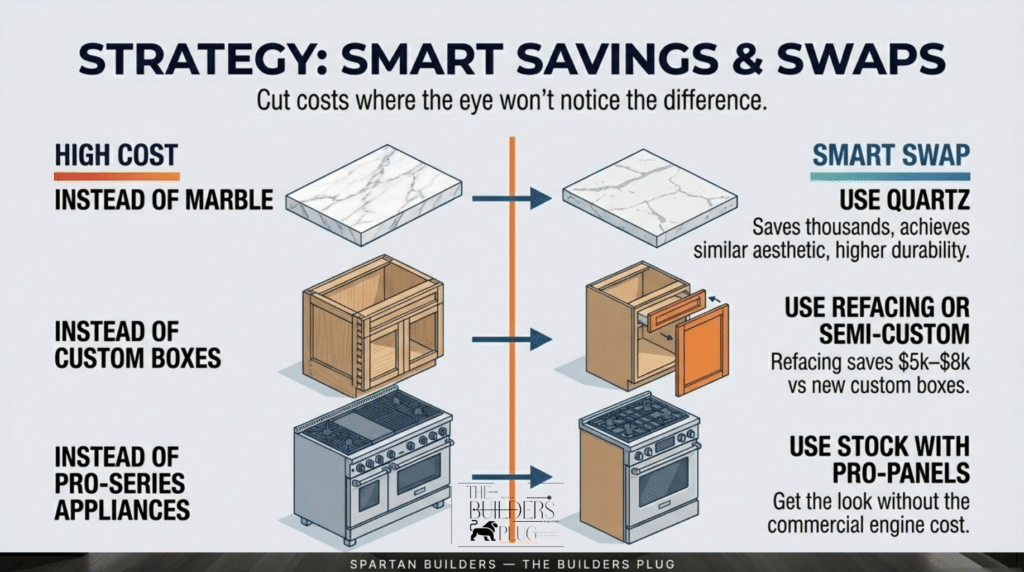
Refacing cabinets can cost $5,000 to $8,000 less than new custom boxes while delivering a comparable visual update. Swapping marble for quartz can save thousands while achieving a similar aesthetic.
Decision framework: resale versus long-term living
Answer three questions to decide where to allocate contingency and shift budget percentages. If you plan to stay five or more years, prioritize durability and performance; if you expect to sell soon, move dollars toward visual updates and neutral finishes. Document priorities before finalizing allowances so your contractor or kitchen designer can tune the remodel cost per square foot and the budget to reflect what matters most.
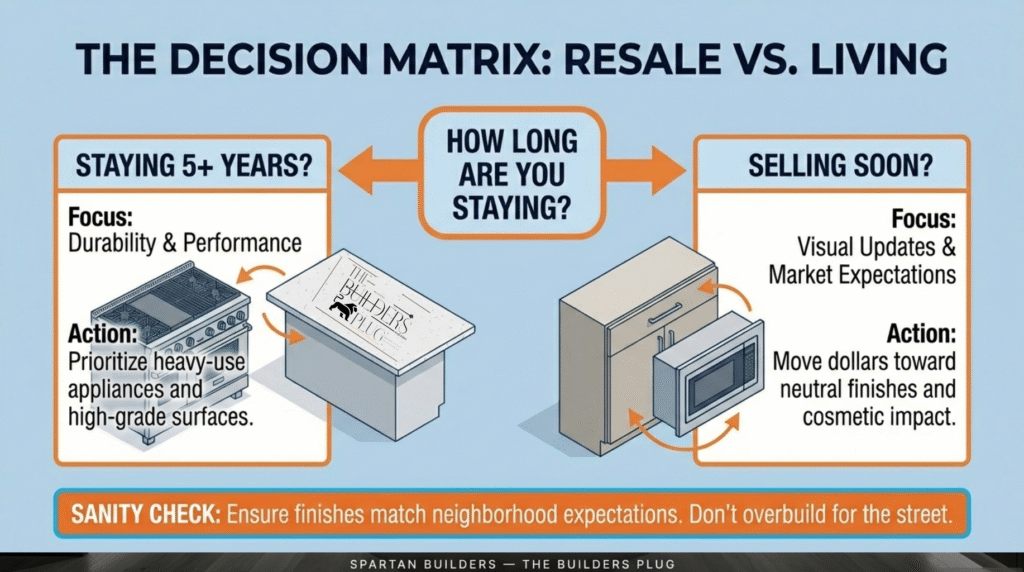
- Staying 5+ years? Prioritize durability and performance.
- Local market expectations? Match finishes buyers expect in your neighbourhood.
- Daily use level? Heavy use justifies higher spend on appliances and countertops.
Build your itemized kitchen budget with sample allocations
Turn percentage ranges into a repeatable workflow using the downloadable template. The step-by-step approach below creates an itemized budget you can share with contractors and designers so estimates align with priorities.
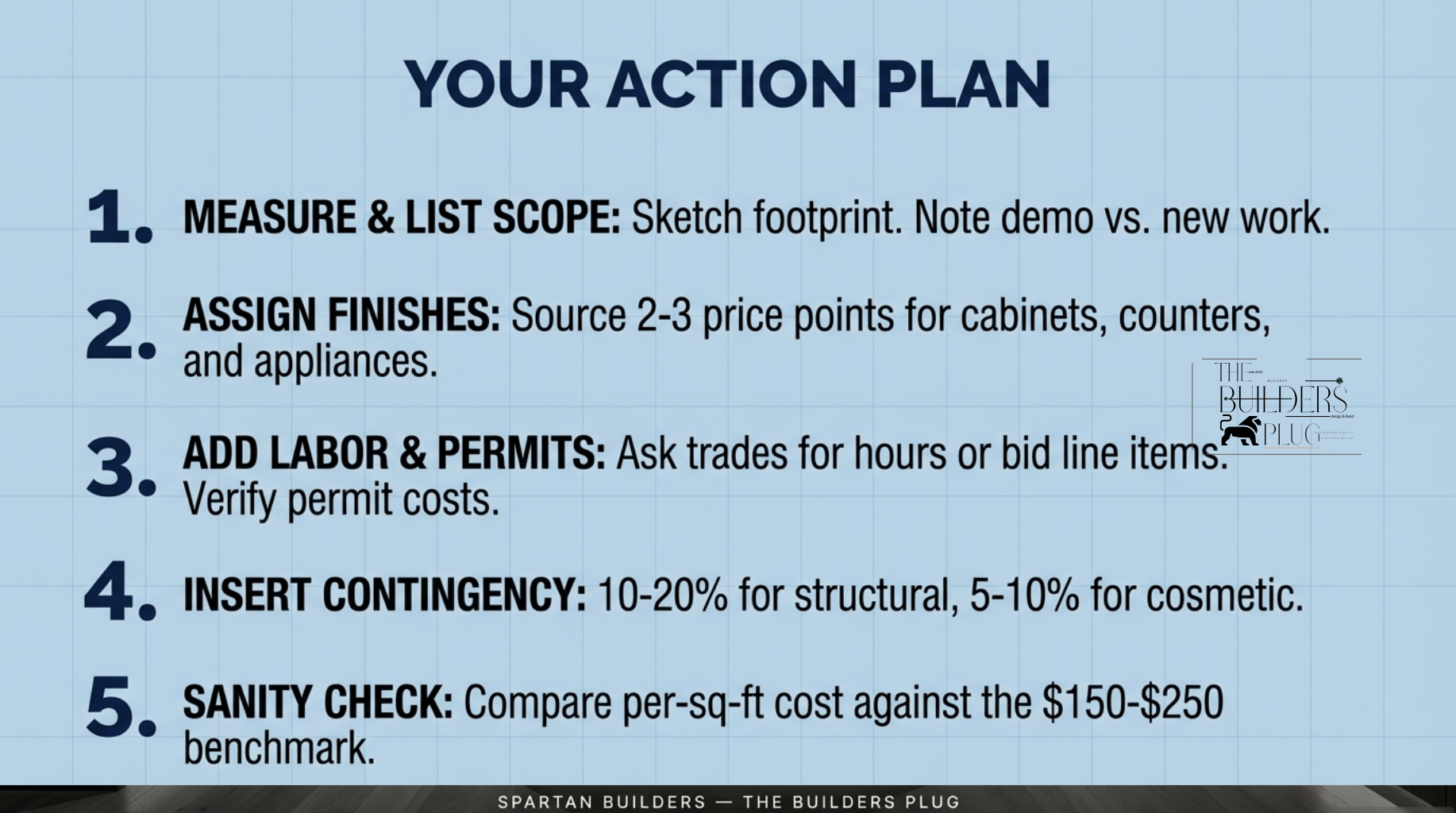
- Measure and list scope: Sketch the footprint and note demolition, new work and must-haves; use photos or a takeoff for accuracy.
- Assign finishes and allowances: Set allowances for cabinets, countertops, appliances and fixtures and source two to three price points for each.
- Add contractor labor, GC fee, permits and inspections: Ask trades for labor hours or bid line items and confirm permit costs with your municipality.
- Insert contingency and approval thresholds: Include a 5 to 10 percent contingency for cosmetic projects and 10 to 20 percent for structural or layout work.
- Compare to sample budgets and adjust: Iterate until totals match your priorities and funding.
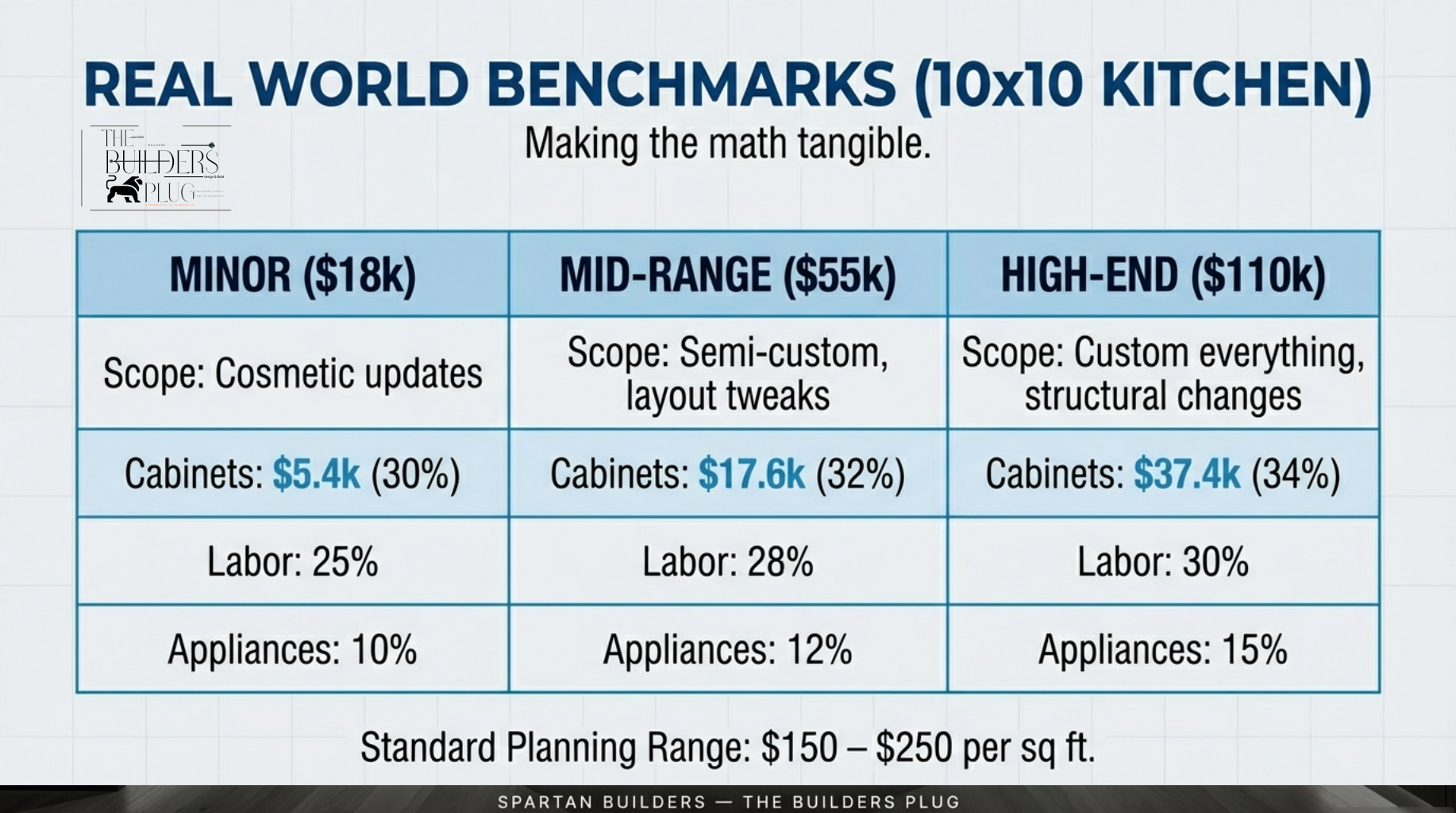
Sample budgets make the math tangible. For a 10 by 10 (100 sq ft) kitchen, representative totals and allocations are:
- Minor: $18,000: Cabinets 30% ($5,400), labor 25% ($4,500), appliances 10% ($1,800), countertops 10% ($1,800), others/perm/contingency 25% ($4,500).
- Mid-range: $55,000: Cabinets 32% ($17,600), labor 28% ($15,400), appliances 12% ($6,600), countertops 10% ($5,500), others/perm/contingency 18% ($9,900).
- High-end: $110,000: Cabinets 34% ($37,400), labor 30% ($33,000), appliances 15% ($16,500), countertops 10% ($11,000), others/perm/contingency 11% ($12,100).
Major layout changes or structural work can push labor toward the high end and inflate contingency. Use a per-square-foot check for early planning — typical remodels run about $150 to $250 per square foot, so a 100 sq ft kitchen estimates at $15,000 to $25,000. When custom cabinetry, structural moves or high-end appliances dominate, switch from per-square-foot metrics to line-item math for the final budget.
Download the budget template and use phased cost-review meetings to stay on budget
The downloadable template is the practical control tool that turns numbers into decisions. Use it to build a clear kitchen renovation budget breakdown you can update in real time and bring to site meetings. The sheet includes quantity, unit cost, allowance, vendor, quoted cost, actual cost, variance, priority and contingency columns so every line item tracks to a decision. A built-in percentage calculator shows allocation math next to sample rows.
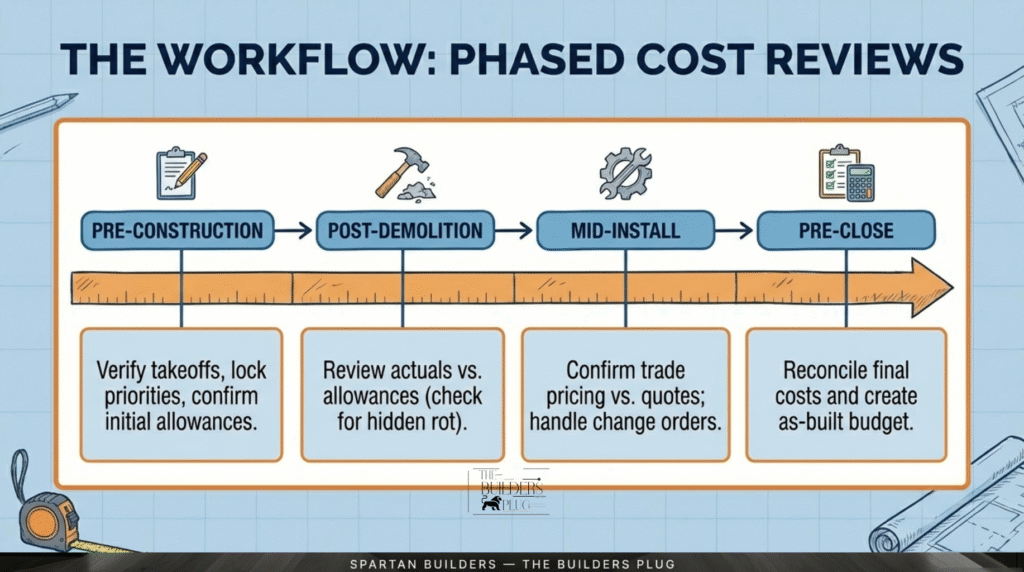
Export the sheet to CSV or PDF for sharing, and print the one-page checklist for on-site reviews and sign-offs. Use pre-construction scope sign-off to verify takeoffs, lock priorities and confirm initial allowances. After demolition, review allowances against actuals, approve upgrades and reassign contingency as needed. Mid-install trade confirmation checks quoted versus actual trade pricing and handles change orders, and the pre-close final walk reconciles final costs and creates the as-built budget.
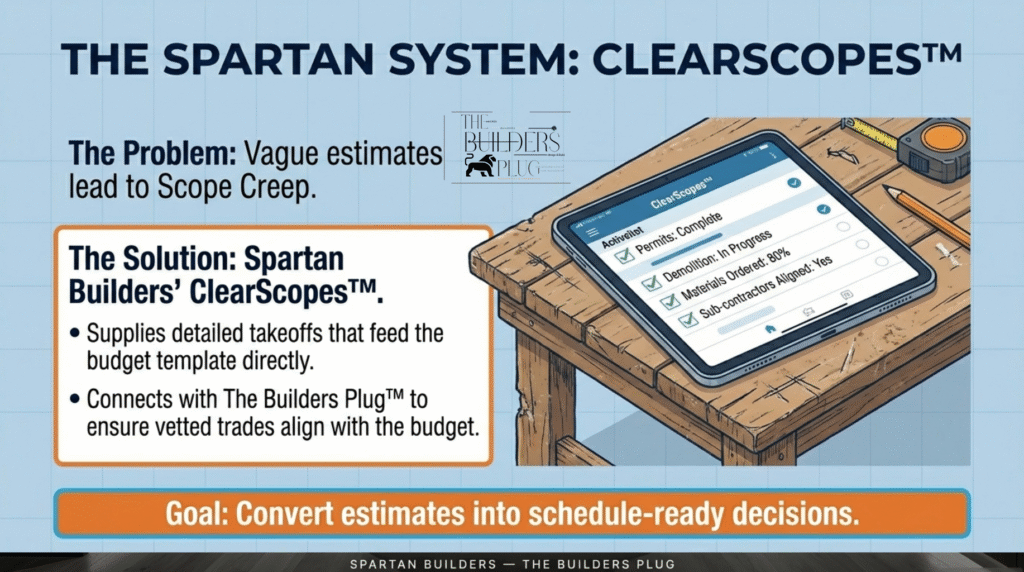
Spartan Builders’ ClearScopes™ supplies the detailed takeoffs that feed the template, and The Builders Plug™ connects vetted trades so quoted work aligns with budget, code and warranty. Use the template together with the phased meeting cadence and you will have a documented trail for every change and a realistic contingency plan. Download the template and book a phased cost-review with Spartan Builders to convert your numbers into a ClearScopes™ takeoff and move into construction with a schedule-ready estimate.
Finish your kitchen renovation budget breakdown with confidence
To get started, measure your kitchen, fill one page of the budget template with cabinet runs and countertop area, and use the template and a takeoff to create a schedule-ready estimate.