







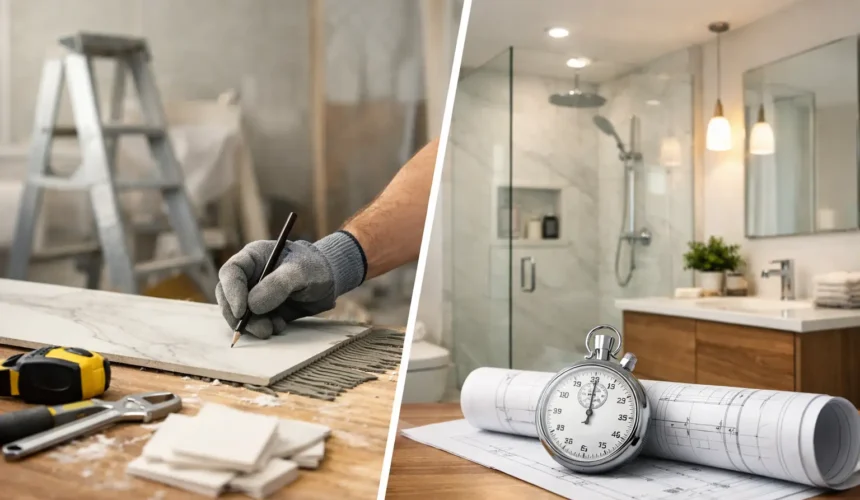
Most bathroom remodel delays do not start with tile. They start weeks earlier with unclear scope, late selections, missing materials, and trades arriving in the wrong sequence.
That is why a realistic bathroom renovation project timeline matters. If you are planning a primary ensuite, family bathroom, or income property upgrade, the real question is not just how many days construction takes. It is how long the full process takes from planning to final completion, and what can push it off track.
What a realistic bathroom renovation project timeline looks like
For a standard full bathroom remodel, most homeowners should expect the full process to land somewhere between 6 and 12 weeks. That range includes planning, selections, procurement, demolition, rough-ins, inspections, waterproofing, finishing, and punch list work. The on-site construction portion alone is often around 3 to 6 weeks, but that number can be misleading if materials are not ordered or permits are still pending.
A cosmetic refresh sits at the shorter end of the range. A full gut renovation with layout changes, custom glass, specialty tile, or structural work moves toward the longer end. If you are renovating in an older home, the timeline can stretch further once walls are opened and hidden conditions appear.
The biggest mistake homeowners make is assuming bathroom work is simple because the room is small. Bathrooms are dense. Plumbing, electrical, ventilation, waterproofing, tile tolerances, and fixture coordination all converge in a tight footprint. A small room often demands more precision, not less.
Phase 1: Planning and scope definition
This is where schedule control is either built or lost.
Before demolition starts, the project needs a defined scope. That means more than saying you want a new vanity, shower, and floor tile. The builder needs exact decisions on layout, fixtures, finishes, access, demolition limits, and whether plumbing or electrical locations are changing. If these details are vague, pricing stays vague and the construction calendar stays vulnerable.
This phase typically takes 1 to 3 weeks, depending on how quickly decisions are made. If the bathroom is part of a larger renovation, planning can take longer because sequencing with adjoining spaces matters.
A disciplined builder will document the work in enough detail to reduce interpretation gaps in the field. That matters because bathroom delays often come from assumptions made too early. One person assumes the existing drain can stay. Another assumes the vanity size is flexible. Then materials arrive and the plan changes midstream.
Phase 2: Design, selections, and procurement
In many projects, this phase overlaps with planning, but it deserves its own attention because it has a direct impact on the bathroom renovation project timeline.
Selections usually take 1 to 2 weeks if the homeowner is decisive and the options are readily available. Procurement can take another 1 to 6 weeks depending on the products. Stock vanities and standard porcelain tile move quickly. Custom millwork, imported tile, specialty plumbing fixtures, and frameless shower glass can add real lead time.
This is one of the strongest arguments for process-led construction. If materials are not fully confirmed before work begins, crews can finish demolition and rough-ins only to wait on a faucet valve, shower niche trim, or vanity top template. That is dead time on the schedule.
The smartest path is to lock key materials early, especially tile, plumbing fixtures, glass, lighting, and cabinetry. Bathrooms depend on exact dimensions. Substitutions made late are rarely simple.
Phase 3: Permits and pre-construction coordination
Not every bathroom remodel requires permits, but many do. If plumbing is relocated, electrical circuits are added, or structural work is involved, approvals may be necessary. In some jurisdictions, permit review can be fast. In others, it can add weeks.
This phase usually runs from a few days to several weeks depending on project complexity and local requirements. Older homes, condo buildings, and multi-unit properties often involve more coordination. Condo boards may require work-hour restrictions, elevator bookings, protection protocols, and insurance documentation before construction starts.
Good pre-construction work also includes site protection, delivery planning, debris removal strategy, and confirming trade sequence. This work is not flashy, but it keeps the project stable once crews are on site.
Phase 4: Demolition and framing
Demolition for a bathroom typically takes 1 to 3 days. If the room is small and access is easy, it can be done quickly. If the house is occupied, dust containment, debris handling, and protection of adjacent finished areas can slow things down, as they should.
Once demolition is complete, framing corrections may be needed. Walls are not always straight. Subfloors may be uneven. In older homes, previous work can be out of code or poorly executed. This is where hidden conditions often show up, including water damage, mold, undersized framing, or dated plumbing and wiring.
That does not mean every project blows up after demolition. It means the schedule should allow for the possibility. A contractor who promises an aggressive timeline before seeing what is behind the walls is often selling optimism, not control.
Phase 5: Rough plumbing, electrical, and HVAC
This phase usually takes 2 to 5 days, depending on the scope.
If fixtures stay in the same location, rough-ins can move quickly. If the shower is expanding, the toilet is shifting, or lighting and ventilation are being upgraded, expect more time. Trade coordination is critical here because rough plumbing, electrical, and exhaust venting all need to work within the same wall and ceiling cavities.
Inspections may be required before walls are closed. If inspection scheduling is slow, the project pauses. That is another reason schedule discipline matters. A builder with a clear sequence and active coordination process is far less likely to lose days between trade handoffs.
Phase 6: Backer board, waterproofing, and tile work
This is the phase homeowners tend to underestimate.
Bathroom waterproofing and tile installation often take 1 to 2 weeks, sometimes longer for larger-format tile, intricate layouts, or custom shower assemblies. Proper waterproofing is not a place to compress time. Materials need to be installed to specification, and some systems require cure time before tile can be set.
Tile also introduces craftsmanship variables. A straight lay with standard tile moves faster than herringbone, niche detailing, wrapped corners, or full-height slab work. If the shower pan is custom-built or the walls need correction for flatness, labor increases.
This is where quality and speed can conflict. Fast tile work that ignores prep, layout, or drying times creates expensive problems later. In bathrooms, schedule pressure should never override waterproofing standards.
Phase 7: Fixtures, paint, glass, and finish work
Once tile is set and cured, the room moves into finish stage. This usually takes 3 to 7 days.
Vanity installation, countertop templating if applicable, plumbing trim, lighting, mirrors, accessories, paint touch-ups, and toilet setting all happen here. Shower glass is often one of the final items, and it can extend the closeout period if measurements were taken after tile completion and fabrication is still in progress.
This phase feels fast compared to the earlier work, but it still requires coordination. A delayed mirror, missing faucet part, or cracked vanity top can hold back completion even when the room looks nearly done.
What most often delays a bathroom remodel
A bathroom renovation project timeline usually slips for a few predictable reasons. The first is incomplete scope. The second is late selections or products with long lead times. The third is poor sequencing between trades. After that, hidden conditions and inspection timing are the most common schedule disruptors.
Homeowners also create delays by making layout or material changes after rough-in work is complete. Some changes are worth making, but they come at a cost in both time and labor. If the goal is predictability, decisions should be made before construction starts, not during it.
There is also a trade-off between speed and customization. A bathroom can be completed faster if you keep the layout, choose readily available materials, and avoid custom fabrication. If you want bespoke millwork, premium tile, and layout modifications, the timeline should reflect that reality.
How to keep the timeline under control
The shortest path is not rushing. It is reducing uncertainty.
That means defining the scope before pricing is finalized, selecting materials early, ordering long-lead items in advance, and working with a builder who treats sequencing and communication as part of the product, not an afterthought. A bathroom remodel has too many moving parts to be managed casually.
This is exactly why process matters. Firms like Spartan Builders build control into delivery through structured documentation, procurement planning, and accountable trade coordination. That does not eliminate every variable, but it does reduce the preventable ones that turn a 4-week construction window into a 10-week disruption.
If you are planning a bathroom renovation, ask better questions before work begins. Ask what is selected, what is still allowance-based, what requires permits, what has been ordered, and what happens if hidden conditions are found. A serious builder should have direct answers.
The right timeline is not the fastest one on paper. It is the one built on real scope, real lead times, and a sequence that holds under pressure. That is what protects your budget, your home, and your patience when the work starts.