








The finished space should feel inevitable.
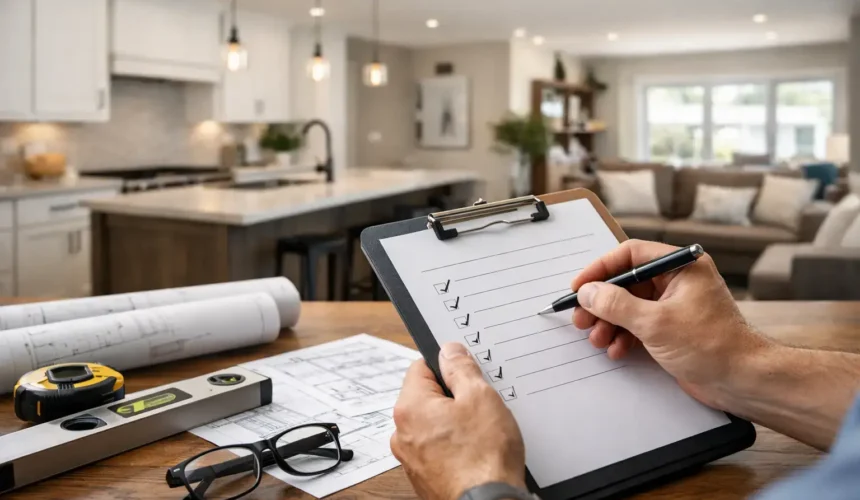
Not lucky. Not surprisingly good. Not “better than expected” after months of chasing answers. Whether you’re planning a full home renovation, a custom addition, a restaurant interior, or a commercial fit-out, the right design build firm creates a project that feels controlled from day one. That is why a design build firm review checklist matters. It helps you judge the team before the drawings stall, the scope drifts, or the schedule starts slipping.
Most clients do not need more sales language. They need a better filter. A polished proposal can hide a weak preconstruction process. A confident meeting can hide unclear trade coordination. And a low number on paper can hide expensive gaps that surface later. The real review happens in the details a firm is willing to document, explain, and stand behind.
What a design build firm review checklist should actually measure
A useful checklist does not focus on charm, vague promises, or how quickly someone says yes. It measures control. Can this firm translate vision into buildable scope? Can they align design, engineering, permits, procurement, scheduling, and execution under one system? Can they keep decisions from becoming delays?
That matters because design-build is only as strong as the handoff between concept and construction. Some firms market themselves as integrated, but still operate like disconnected departments. Design is one conversation. Construction is another. The client ends up carrying information between them. That is not integration. That is administrative debt.
A strong review process should reveal whether the firm works as one coordinated team or just bundles services under one name.
Review the scope before you review the price
If the scope is thin, the number means very little.
This is one of the biggest mistakes clients make. They compare proposals before confirming that each firm is pricing the same project. One proposal may include demolition details, finish specifications, trim profiles, cabinetry internals, permit coordination, and site protection. Another may describe the same project in three broad paragraphs. Those are not equal offers, even if they look close at first glance.
Ask to see how the firm documents scope. Is there a room-by-room breakdown? Are materials identified clearly? Are exclusions stated plainly? Are allowances limited and intentional, or are they doing too much of the heavy lifting? Every missing decision becomes a future change point.
The best firms remove ambiguity before construction begins. They make the invisible visible. That protects the design, the budget, and the timeline all at once.
Signs the scope is strong
A solid scope document reads like execution, not marketing. It should define what is being built, what materials are assumed, what level of finish is included, who is responsible for selections, and where decisions still need to be finalized. It should also show that the firm understands sequencing. There is a difference between listing tasks and planning a project.
For homeowners, this often shows up in kitchens, bathrooms, full-home remodels, and additions where hidden conditions and finish coordination can change everything. For commercial clients, it shows up in code requirements, landlord coordination, schedule compression, and operational constraints.
Evaluate the design-build structure itself
Not every design build firm is built the same.
Some are construction-led with light design support. Some are design-led and outsource most build management. Some truly integrate interior design, technical planning, engineering coordination, procurement, and site execution. Your checklist should uncover which model you are actually hiring.
Ask who leads the project in preconstruction and who owns it once work begins. If the people who sell the job disappear after contract signing, that is a warning sign. If the designer is not aligned with the build team on material lead times, detailing, and constructability, expect friction. If engineering input arrives late, expect redesign and delay.
The strongest firms think across disciplines from the start. They do not design in a vacuum. They design with real construction knowledge behind the decisions.
Questions worth asking
Who prepares the scope? Who verifies field conditions? Who coordinates consultants? Who updates the schedule? Who communicates changes? Who has final accountability when design intent and site realities conflict?
These are not minor details. They define whether your project will feel organized or improvised.
Check trade quality through standards, not claims
Every builder says they use good trades. That statement is empty unless it is backed by standards.
Your design build firm review checklist should look at how trade partners are selected, managed, and held accountable. Are they licensed where required? Insured? Familiar with the firm’s standards and documentation? Do they work from clear scopes and coordinated drawings, or are they expected to figure things out on site?
Good trades can still underperform inside a weak system. That is the part many clients miss. Craftsmanship does not live in talent alone. It lives in preparation, sequencing, supervision, and quality control. The cleaner the inputs, the better the output.
Ask how the firm handles deficiencies, inspections, and finish review. Ask whether the same core trade network is used consistently or whether crews change job to job. Predictability matters. A vetted network usually produces cleaner execution than a rotating bench of whoever is available.
Review communication like it is part of the build
Because it is.
Most project frustration is not caused by one catastrophic mistake. It comes from silence, vague updates, shifting expectations, and decisions that are made too late. A firm can be technically capable and still create a poor client experience if communication is reactive.
Your checklist should include how often updates are given, what format they follow, and who sends them. Is there milestone tracking? Are pending decisions flagged early? Are change requests documented before work proceeds? Can you see what has been completed, what is next, and what is waiting on approval?
Clear communication is not customer service theater. It is project control. It reduces rework, protects schedules, and keeps the client from becoming a project manager by default.
For professional partners such as designers and architects, this matters even more. Your reputation is attached to the build team’s ability to report clearly, coordinate faithfully, and execute to specification without constant intervention.
Pay attention to how the firm handles risk
Every construction project has unknowns. The difference is how a firm prepares for them.
A disciplined team does not pretend surprises never happen. They show you where the variables are likely to live and how they will manage them. That may include investigative site visits, measured documentation, consultant review, permit planning, lead-time analysis, and contingency discussion around existing conditions.
Be cautious with firms that make everything sound simple too early. Confidence is valuable. Oversimplification is expensive.
A strong design-build partner will identify pressure points before they become claims, delays, or rushed decisions. They will also explain trade-offs honestly. Sometimes the fastest route is not the best route. Sometimes preserving design intent requires more coordination upfront. Sometimes a phased approach protects operations better than an aggressive schedule. Good firms can explain those choices without turning the process into fog.
Use references to verify systems, not just satisfaction
References matter, but ask better questions.
Do not stop at “Were you happy with the result?” Most people judge based on the final reveal. You need to know how the firm performed under pressure. Ask whether the original scope was well defined. Ask whether changes were explained clearly. Ask whether scheduling felt reliable. Ask whether issues were resolved quickly and documented properly.
If possible, look for references that match your project type. A firm that performs well on cosmetic remodels is not automatically the right choice for a full gut renovation, addition, or occupied commercial build-out. Complexity changes the standard.
This is also where process-led firms stand apart. When a company has a documented scope system, a vetted trade network, and a structured delivery model, clients usually describe the same experience in different words: clarity, control, fewer surprises, and less chasing.
The final filter in your design build firm review checklist
By the end of your review, you should be able to answer one question with confidence: does this firm reduce uncertainty, or simply package it better?
That is the real test.
A great design-build firm gives you more than drawings and labor. It gives you alignment. Design decisions connect to real costs. Field conditions connect to real planning. Trades move in sequence. Communication stays ahead of problems. The project feels managed because it is.
That is the standard process-led builders work toward. Spartan Builders approaches projects through complete scope definition, vetted trade coordination, and structured delivery because beautiful spaces are not created by momentum alone. They are created by control.
When you review firms this way, the right choice becomes easier to see. Not because the pitch is louder, but because the system is stronger. And when the system is strong, the finished space feels exactly the way it should – considered, resolved, and built with purpose from the start.