







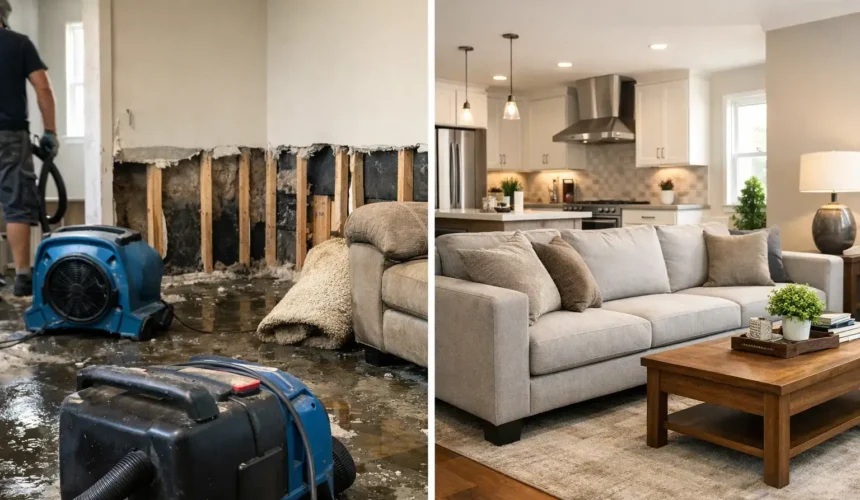
A flooded home can still become the calm, finished space you recognize as yours. Floors sit level. Walls feel solid. Cabinetry closes cleanly. The air is dry, quiet, and free of the hidden damage that creates problems months later. That outcome begins with one decision: restoration versus replacement after flood damage.
The wrong answer can leave moisture inside a wall, compromise a material that looked acceptable on the surface, or spend claim dollars replacing elements that could have been safely preserved. The right answer is not based on appearances alone. It is based on water category, exposure time, material behavior, structural conditions, code requirements, and a documented plan for returning the property to a better state of control.
Restoration Versus Replacement After Flood: Start With Evidence
Flood damage is rarely limited to what the eye can see. Water travels beneath flooring, through insulation, behind baseboards, into framing cavities, and along mechanical penetrations. A clean-looking wall can hold elevated moisture. A floor that feels dry can have a damaged underlayment. A cabinet may appear intact while its particleboard base has begun to swell.
This is why the first phase is assessment, not demolition and not assumption. The team needs to identify the source of water, classify the contamination risk, map the migration path, measure moisture levels, and determine which assemblies can be dried to an acceptable condition.
Water from a clean supply line is assessed differently than water from a sewer backup or exterior flooding. The longer materials remain wet, the more the decision shifts toward removal. Porous materials absorb quickly and often lose integrity. Dense materials may be recoverable, but only if drying can be confirmed rather than guessed.
A controlled assessment creates the record that guides the claim and the rebuild. It separates necessary work from speculative work. More importantly, it prevents a property owner from approving a partial solution that looks finished but leaves the building compromised.
What Can Often Be Restored
Restoration is appropriate when a material can be cleaned, dried, stabilized, and returned to its intended performance without creating a future liability. It is not a shortcut. It is a technical decision supported by conditions on site.
Structural framing can often be preserved when it has not decayed, warped, or remained saturated long enough to support microbial growth. With proper access, controlled drying, and verification, framing may return to acceptable moisture levels. Concrete and masonry can also be restored in many cases, though adjacent finishes and insulation usually require separate evaluation.
Certain non-porous finishes may be candidates for restoration. Tile, stone, metal, and some solid-surface materials can often be cleaned and retained if their substrates remain sound. Hardwood flooring is more nuanced. A limited clean-water event may allow for drying and refinishing when boards have not cupped, separated, or released from the subfloor. A prolonged event usually changes that answer.
Custom cabinetry deserves a careful evaluation. Solid wood components may be salvageable under the right conditions. Cabinet boxes made from particleboard or medium-density fiberboard generally do not recover well after saturation. Swelling, delamination, and loss of structural strength can continue even after the visible surface dries.
The goal is not to save every material. The goal is to preserve what can perform as intended and replace what cannot.
When Replacement Is the Safer Decision
Replacement becomes necessary when a material cannot be fully dried, has absorbed contaminated water, has lost structural integrity, or would require disproportionate intervention to deliver an uncertain result.
Drywall and insulation are common examples. Once water enters a wall assembly, the decision depends on the water source, the height of absorption, how long the materials were wet, and whether the cavity can be accessed and dried. In many flood events, selective removal is required to expose framing, remove compromised insulation, and create a clean drying path.
Flooring systems also demand more than a surface-level inspection. Laminate flooring typically swells at joints and edges after exposure. Engineered wood may delaminate. Vinyl plank can sometimes be removed and reinstalled only if the product, adhesive condition, and subfloor all allow it. Carpet and pad often require replacement, particularly after contaminated water exposure.
Replacement is also the right call when building code or the original condition creates an opportunity to correct a deeper issue. An opened wall may reveal missing insulation, outdated assemblies, inadequate fire separation, or framing damage unrelated to the flood. Closing it back up without resolving those conditions is not restoration. It is postponement.
Contaminated Water Changes the Equation
Not all water damage carries the same health and cleaning requirements. Water from sewage, rising exterior water, or other contaminated sources can introduce bacteria, chemicals, and debris into porous materials. In those cases, the question is not whether a material appears dry. It is whether it can be safely returned to service.
Porous finishes exposed to contaminated water frequently need removal. This includes many types of insulation, drywall, carpet, fabric-backed materials, and wood-based products. Hard, non-porous surfaces may be cleaned and disinfected when their condition permits, but they still require documented evaluation.
A disciplined decision protects the people returning to the space. It also protects the integrity of the claim file.
The Cost of Choosing Too Early
A fast answer feels reassuring after a flood. It can also be expensive. Replacing everything before the assessment is complete may create unnecessary scope, delays, and disputes. Trying to restore everything can be worse, especially when hidden moisture leads to repeat demolition after finishes are installed.
The best decision often sits between those extremes. It may mean restoring framing, tile, and selected millwork components while replacing drywall, insulation, flooring, and cabinet boxes. It may mean opening only the affected portions of a wall rather than removing an entire room. Or it may mean a full rebuild of a damaged area because the water path and material conditions leave no defensible alternative.
The difference is documentation. Moisture readings, photographs, material observations, demolition limits, drying verification, and defined reconstruction scopes turn an emotional event into a managed project.
From Emergency Work to a Finished Rebuild
Drying the property is only the first milestone. The rebuild determines how the space will live when the disruption is over.
A strong restoration plan coordinates mitigation findings with architectural intent, material availability, insurance requirements, trade sequencing, and code compliance. Without that coordination, a home can move from emergency response into a second phase of confusion: missing selections, unclear allowances, trades arriving out of sequence, and decisions made under pressure.
Spartan Builders approaches large-loss restoration as a controlled construction project. ClearScope™ documents the work before reconstruction begins, including material specifications, scope boundaries, and the conditions that must be resolved. The Builders Plug™ brings licensed, insured trades into a coordinated network. The Spartan System™ sequences the work, tracks milestones, and keeps the client informed without making them chase answers.
That structure matters when restoration transitions into replacement. A homeowner may decide to use the opening created by flood repairs to improve a basement layout, update cabinetry, or correct a finish that no longer serves the room. Those decisions can add value, but they must be clearly separated from the covered restoration scope. Clear boundaries protect both the insurance process and the final construction plan.
Questions That Lead to the Right Scope
Before approving restoration or replacement work, property owners should expect direct answers. What category of water entered the space? Which materials were tested, and what did the readings show? Where did water travel beyond the visible damage? What can be dried and verified? What must be removed? Which conditions are part of the insurance restoration scope, and which are elective improvements?
The answers should be specific to the property. General promises are not enough. A flood-affected kitchen, finished basement, office, or retail space has layers of finish, structure, services, and code obligations that need to be coordinated as one system.
For commercial spaces, the stakes include operational continuity. A decision to retain or replace flooring, partitions, casework, or ceiling systems affects reopening dates, inspections, tenant requirements, and the customer experience. The same assessment discipline applies, but the reconstruction sequence must also protect the business timeline.
Build Back With Confidence, Not Hope
Restoration is not automatically the more economical choice. Replacement is not automatically the more thorough one. Each has a place, and each must be earned by evidence.
The finished result should not carry reminders of the flood in the form of soft flooring, swollen cabinetry, lingering odors, or unexplained stains. It should feel resolved. Dry where it needs to be dry. Sound where it needs to carry load. Finished with materials that belong in the space.
When the scope is clear before the rebuild begins, a flood becomes a defined construction event rather than an open-ended disruption. That is how a damaged property returns not merely repaired, but ready for the life and work happening inside it.